
A closed interior door should remain still.
It should not move when someone walks past, another door closes nearby or the HVAC system starts moving air through the house.
If the door rattles inside the jamb, the slab itself is not necessarily damaged. In many cases, the latch is holding the door in a slightly different position from the door stop.
That small amount of movement may be only a millimetre or two.
But every time air pressure changes or the door is touched, the slab moves between those two positions and creates the sound.
The usual question is not simply, “How do I make the door tighter?”
The better question is:
Why is the closed door still able to move?
★★★★★
76 Google Reviews.
Earned One Job at a Time.
Real projects. Real homes. Real customers.
Wood Job Finish Carpentry is an owner-led finish carpentry business installing interior doors in Oakville, Milton, Mississauga, Burlington, Cambridge, Guelph, Kitchener, Hamilton, Vaughan, Toronto and surrounding areas.
The Most Common Cause: Space Between the Latch Position and Door Stop
The latch extends from the edge of the door into the strike plate on the jamb.
Once engaged, it should hold the door securely in its closed position. At the same time, the face of the door should rest consistently against the door stop.
These parts work together:
- The latch and strike keep the door closed.
- The door stop establishes where the closed door sits.
- The hinges control the swing and support the slab.
- The jamb holds all these parts in their correct relationship.
If the strike plate holds the latch while the door is still slightly away from the stop, the slab has room to move.
You can usually feel this by closing the door and lightly pushing and pulling it without turning the handle. If the door moves back and forth while the latch remains engaged, that movement is normally the source of the rattle.
The sound may become more noticeable when:
- The furnace or air conditioner starts
- An exterior door is opened or closed
- Another bedroom door closes
- A window is open
- Someone walks heavily through the hallway
- The handle is touched without fully operating it
The air movement does not necessarily cause the problem. It often reveals clearance that was already there.
Why Door Stop Position Matters
The door stop is the narrow strip attached to the jamb that the closed door rests against.
It may look like a simple piece of trim, but its position affects how the door closes, how the latch holds it and whether the slab sits consistently from top to bottom.
If the stop is too far away, the closed door may remain latched but still move inside the jamb.
If one section of the stop touches the door while another section does not, the door may feel tight at one point and loose at another. It can also produce a different sound depending on where the slab is pushed.
A correctly positioned stop should meet the closed door evenly along the latch side. The head stop should also meet the top of the door without pushing the slab out of its natural position.
The hinge side needs a very small working allowance because the edge of the door travels through an arc as it closes. Setting that section too tightly can cause the door to contact the stop before it fully closes.
The goal is consistent contact—not pressure everywhere at any cost.
How I Position Door Stops During a New Installation
When a Wood Job project includes both the door and hardware installation, I normally install the handle, latch and strike plate before permanently fastening the door stops.
There is a practical reason for that sequence.
After the hardware is working, I close the door and allow the latch to engage with the strike plate. This gives me the door’s actual closed position—not an assumed position established before the hardware was installed.
I can then place the door stop against the closed slab and fasten it so the door meets the stop consistently from top to bottom.
The completed relationship creates two controlled contact points:
- The latch and strike hold the door toward the stop.
- The stop prevents the slab from travelling farther into the jamb.
When those positions agree, the door closes without unnecessary movement. The customer should not need to push, pull or lift the handle to find the right spot.
This sequence also lets me check the final operation before the stop position becomes fixed:
- Does the latch engage cleanly?
- Does the handle release without unnecessary resistance?
- Does the door meet the stop evenly?
- Is the slab being twisted to make it close?
- Is there enough allowance for paint?
- Does the door remain quiet without feeling over-tight?
Door installation is a relationship between the slab, jamb, hinges, latch, strike plate and stop. Treating each part separately can leave a door that technically closes but never feels quite right.
This same relationship also affects the gap around a door and normal room-to-room sound control. My guide to whether solid-core interior doors make a home quieter explains why the slab alone does not determine the final result.
What If the Hardware Is Installed Later?
Sometimes Wood Job installs the door while the homeowner, painter or another contractor plans to supply or install the handles later.
The door stop can still be positioned during the carpentry work. The door can be held in its intended closed position while the stop is fitted.
However, the final relationship cannot be fully tested until the actual latch and strike plate are installed.
Once the hardware is added, the door should be checked again. A different latch, backset or strike position may hold the slab slightly farther inward or outward than expected.
The door may then require a final strike plate or stop adjustment.
This is one reason it is helpful to have the selected hardware available during the door installation whenever possible.
The Strike Plate May Be in the Wrong Position
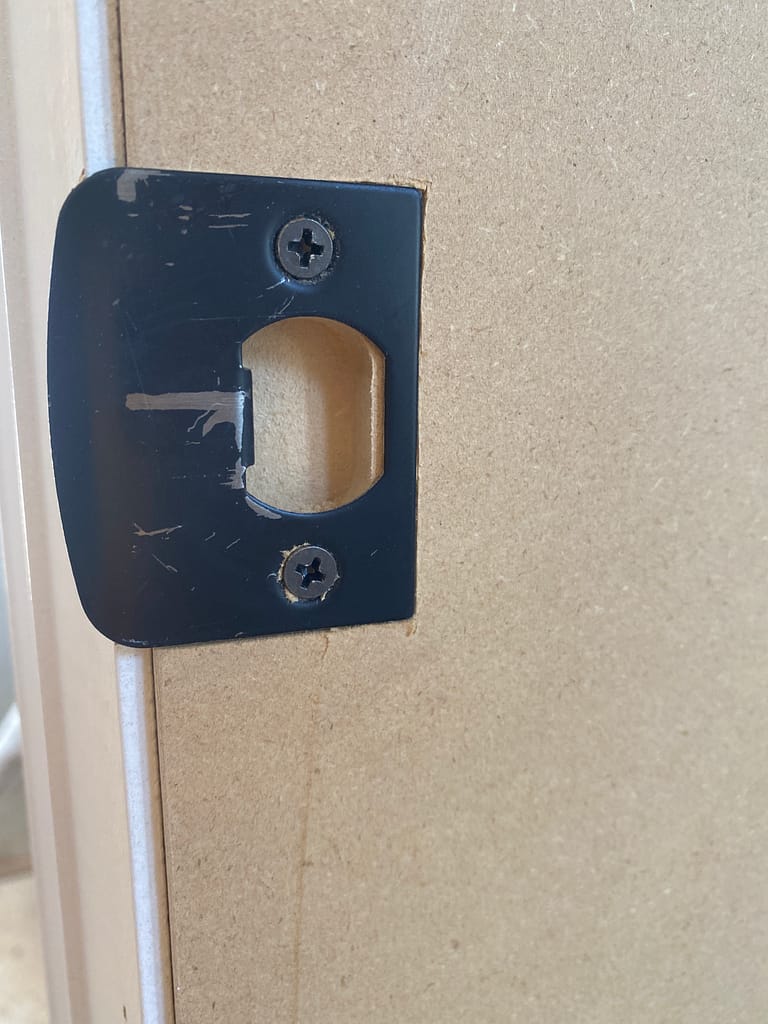
A strike plate installed slightly too far toward the room can allow the latch to engage before the door reaches the stop.
The door appears closed, but it still has room to move.
A strike installed too far in the opposite direction can create the reverse problem. The door may need to be pushed firmly before the latch catches, or the handle may feel unnecessarily difficult to operate.
The correct strike position should allow the latch to engage without a shoulder push while holding the door naturally against the stop.
Some residential strike plates include a small adjustable tab inside the latch opening. Depending on the hardware, carefully adjusting this tab may remove a small amount of movement without relocating the complete plate.
That can be useful for a minor rattle.
It is not a cure for a badly positioned strike plate, twisted jamb or incorrectly installed stop.
If the latch visibly hits above or below the strike opening, the problem is alignment rather than simple closed-door movement. My guide to interior doors that rub, stick, swing open or will not latch covers those wider alignment symptoms.
A Tight Door Is Not Necessarily a Correctly Adjusted Door
It is possible to eliminate a rattle by making the door too tight.
That does not make it a good correction.
If the strike plate is moved too far or the stop is pressed too firmly against the slab, the latch can be placed under constant pressure. The homeowner may then have to pull or push the door while turning the handle.
You may notice:
- A handle that feels harder to turn
- A latch that does not retract smoothly
- The door springing open when released
- A loud snap when the latch disengages
- Marks where the stop presses against the painted door
- A door that works before painting but rubs afterward
The door should be secure when closed but easy to release.
Quiet and over-tight are not the same thing.
Loose Handles and Latch Hardware Can Create Their Own Noise
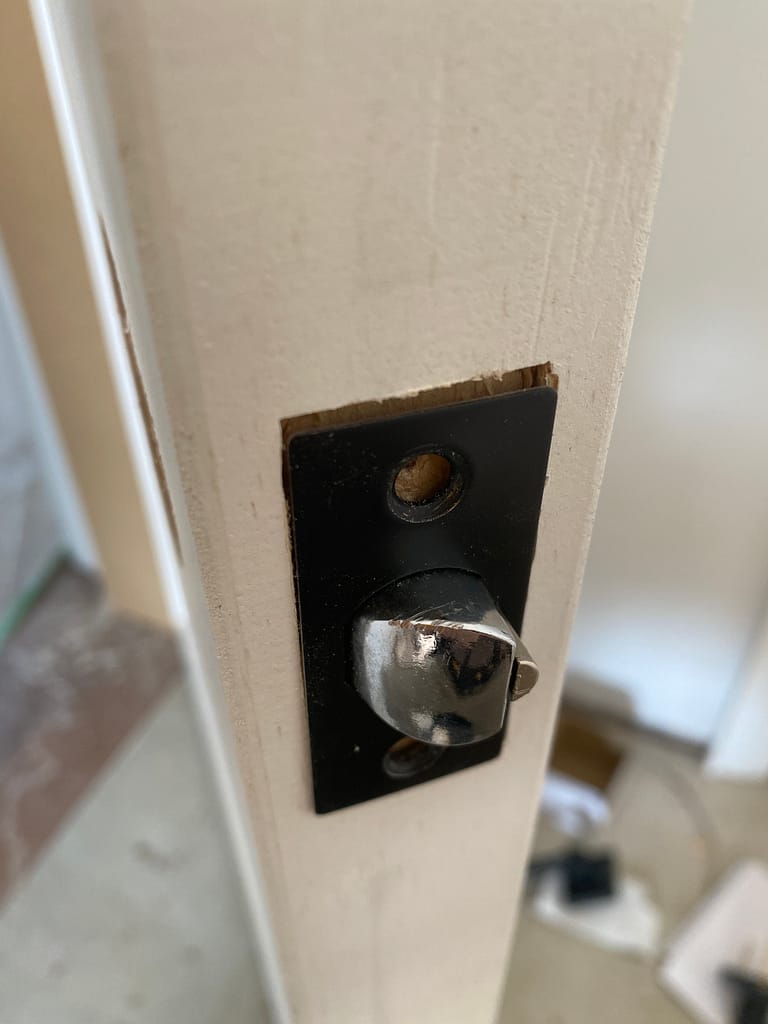
Not every rattle comes from movement between the slab and stop.
A loose handle or lever can create a metallic sound even when the door itself is sitting properly. Loose mounting screws may allow the two sides of the handle assembly to move against the door faces.
The latch mechanism can also move inside an oversized or poorly prepared bore.
Check whether:
- The handles move independently of the spindle
- The lever sags when released
- The mounting screws are loose
- The latch faceplate moves at the door edge
- The strike plate moves against the jamb
- The sound comes from the hardware rather than the slab
Tightening the correct screws may solve this type of noise.
Do not keep tightening once the hardware is secure. Overtightening can cause some handles or latches to bind.
Loose Hinges Can Change the Latch Position
A door can begin rattling after working properly for months or years.
Loose hinge screws are one possible reason.
Even a small amount of hinge movement can allow the door to settle. The latch may still enter the strike plate, but it may no longer land in the same position.
Look for:
- Hinge leaves moving when the door is lifted
- Screws turning without tightening
- A wider reveal above the latch side
- The door sitting lower than before
- The latch rubbing the lower edge of the strike plate
- Dark marks around a moving hinge
A loose screw and a stripped screw are not the same condition. If the screw turns continuously without becoming secure, the jamb or framing behind it may need repair rather than another round of tightening.
Heavier solid-core doors place more demand on the hinges and jamb than lightweight hollow-core slabs. Before fitting a heavier replacement into an existing opening, the frame should be checked for strength and alignment.
Homeowners considering this approach can read Can You Replace Interior Doors Without Replacing the Frame? before deciding to keep the old jamb.
The Jamb May Be Moving
Sometimes the visible hardware is secure, but the jamb itself is not.
A poorly shimmed or lightly fastened jamb can move when the door closes. This changes the relationship between the hinges, strike plate and stop.
You may see the casing move slightly with the jamb or notice that the problem changes depending on how firmly the door is closed.
This is no longer a simple strike adjustment.
The casing may need to be removed so the opening, shims and jamb fastening can be inspected. Moving the strike plate repeatedly will not stabilize a jamb that is loose behind the trim.
These are among the existing door and trim conditions included on Wood Job’s Finish Carpentry Problems We Fix page.
Seasonal Movement Can Make the Problem Appear or Disappear
Wood doors, wood jambs and the framing around them respond to changes in humidity.
During more humid months, materials may expand slightly. During dry heating season, they may contract.
Paint and caulking can also change how tightly the door meets the stop.
A door that feels firm in summer may develop a small rattle during winter. Another may become tighter when the humidity rises.
Before making a major correction, consider:
- When the problem began
- Whether it happens throughout the year
- Whether the door was recently painted
- Whether the indoor humidity has changed
- Whether the door also rubs during another season
- Whether gaps around the slab have visibly changed
A small seasonal adjustment may be appropriate. Repositioning several parts of the opening during an unusual humidity period may create a different problem when conditions return to normal.
Paint Thickness Can Change the Final Fit
Fresh paint adds material to the door edges and stops.
The amount is small, but door clearances are also small.
A stop positioned tightly against an unfinished slab may become a rubbing point after both surfaces receive primer and finish coats. Paint buildup around the latch or strike plate may also affect how smoothly the hardware operates.
When stops are installed before painting, the final coating should be considered. The door needs enough working allowance to operate after the finish is complete.
This does not mean leaving a visible gap around the entire stop.
It means avoiding a fit that already depends on unfinished surfaces remaining exactly as they are.
How to Identify Where the Rattle Comes From
A simple check can narrow down the cause:
- Close the door normally and allow the latch to engage.
- Without turning the handle, push and pull the door gently.
- Watch the gap between the door and stop.
- Listen to whether the sound comes from the slab, handle, latch or hinges.
- Press the door lightly toward the stop.
- Check whether the sound disappears while pressure is applied.
- Look at the stop from top to bottom for areas without contact.
- Operate the handle and notice whether it already feels tight.
- Check the hinge and strike screws for visible movement.
- Compare the reveal around the door.
If light pressure toward the stop removes the rattle and the handle still operates normally, a minor strike adjustment may be enough.
If the door also rubs, drops, swings by itself or misses the strike plate, the complete alignment should be assessed.
When a Small Adjustment May Be Enough
A minor correction may solve the problem when:
- The slab has only slight movement
- The door otherwise swings properly
- The reveals remain balanced
- The hinges and jamb are secure
- The latch enters the strike cleanly
- The handle operates without resistance
- The stop already meets most of the door evenly
Possible corrections include:
- Adjusting the strike plate tab
- Repositioning the strike plate slightly
- Tightening secure hinge or hardware screws
- Refitting one section of loose door stop
- Replacing damaged or unsuitable hardware
The adjustment should address the cause without creating a new operating problem.
When the Door Needs More Than a Strike Adjustment
A broader inspection is sensible when:
- The latch misses the strike opening
- The door must be lifted to close
- The slab rubs the jamb or flooring
- The top or side reveals are visibly uneven
- The door swings open or closed by itself
- The jamb or casing moves
- Hinge screws are stripped
- The stop touches at one point but has a large gap elsewhere
- The handle remains difficult after adjustment
- Several doors in the home have the same issue
- The opening was never completed properly
In these situations, moving the strike plate may only hide one symptom.
The hinge position, jamb alignment, floor clearance, slab size and stop installation may all need to be checked together. Wood Job’s interior door installation and replacement service explains what should be considered before deciding whether to adjust the existing opening or replace part of it.
A Closed Door Should Feel Settled
An interior door does not need to be squeezed tightly into the jamb to remain quiet.
It needs the parts around it to agree.
The hinges should support the slab. The latch should meet the strike plate cleanly. The hardware should operate without resistance. The door stop should meet the closed door consistently without forcing it out of position.
When the door can move while latched, the rattle is usually telling you there is unused space somewhere in that relationship.
Sometimes the correction is small.
Sometimes the noise reveals a larger installation problem.
The important part is identifying which condition exists before moving hardware or trim.
Need Help Assessing a Rattling Interior Door?
For a single door, send:
- A photo showing the complete closed door
- Close photos of the hinges, latch and strike plate
- A short video showing the movement and sound
- A photo of the gaps around the slab
- Information about whether the door rubs or swings by itself
- The project city
- The number of doors with the same problem
- Whether the hardware or door was recently installed
Wood Job can review whether the condition appears to be a small hardware adjustment, a door stop problem or part of a wider jamb and alignment issue.
Project details can be sent through the photo-based estimate page.
Interior Door Rattle Questions
Why does my interior door rattle when the HVAC turns on?
Air-pressure changes can move a door that has clearance between its latched position and the door stop. The HVAC may reveal the movement, but the underlying cause is usually the fit between the latch, strike plate and stop.
How can I tell whether the door or handle is rattling?
Close the door and gently press the slab toward the stop. If the sound disappears, the slab is probably moving inside the jamb. If the sound remains around the handle, check the lever, mounting screws and latch mechanism.
Can I adjust the strike plate to stop the rattle?
Sometimes. A small adjustment may hold the door closer to the stop. The latch must still engage and release smoothly. Moving the strike too far can make the door difficult to close or the handle hard to operate.
What is the purpose of the door stop?
The door stop establishes the resting position of the closed door and prevents it from swinging farther through the jamb. Its position affects the final fit, latch operation and contact around the slab.
Should the door touch the stop from top to bottom?
Along the latch side, the closed door should meet the stop consistently from top to bottom. The hinge side requires a slight working allowance so the swinging edge does not bind before the door closes.
Should hardware be installed before the door stop?
When Wood Job is responsible for the hardware installation, I prefer to install the handle, latch and strike plate before permanently fastening the stops. This lets me position the stops against the door in its actual latched position.
Can loose hinges cause a door to rattle?
Yes. Hinge movement can allow the slab to settle and change where the latch meets the strike plate. Loose or stripped screws should be corrected before the strike position is adjusted.
Can seasonal humidity cause an interior door to rattle?
Yes. Doors, jambs and framing can expand or contract as indoor humidity changes. A small seasonal gap may appear during dry months and tighten again when humidity rises.
Why did the door begin rattling after it was painted?
Paint adds thickness to the door edges, stop and hardware areas. It can change where the slab rests or how the latch operates, particularly if the original clearances were already very tight.
When should a rattling door be inspected by a finish carpenter?
An inspection is useful when the door also rubs, swings by itself, misses the strike, has uneven reveals, moves with the jamb or remains difficult to operate after a minor hardware adjustment. Those symptoms may indicate a wider installation problem rather than a simple rattle.




