
Many homeowners choose solid-core interior doors for the same reason: they want more privacy and less noise moving between rooms.
The short answer is yes. Replacing a lightweight hollow-core door with a solid-core door can make a bedroom, bathroom, nursery or home office noticeably quieter.
But a solid-core interior door is not automatically a soundproof door.
The construction of the slab matters. So do the gaps around it, the clearance beneath it, the door stop, the latch position and the quality of the installation. A heavy door fitted poorly can allow more sound through than a homeowner expects.
Before paying more for solid-core doors, it helps to understand where the improvement comes from—and where it can be lost.
★★★★★
76 Google Reviews.
Earned One Job at a Time.
Real projects. Real homes. Real customers.
Wood Job Finish Carpentry is an owner-led finish carpentry business replacing interior doors in Oakville, Milton, Mississauga, Burlington, Cambridge, Guelph, Kitchener, Hamilton, Vaughan, Toronto and surrounding areas.
Why Solid-Core Doors Usually Reduce More Noise
Sound travels easily through lightweight materials and open gaps.
A typical hollow-core interior door has thin outer skins supported by a lightweight internal structure. It is useful, affordable and easy to operate, but it does not contain much mass.
A solid-core door is heavier and denser. That additional mass helps resist the movement of sound through the slab.
The improvement can be particularly noticeable with:
- normal conversation
- television sound
- home-office calls
- children playing in adjacent rooms
- general household activity
- bedroom and bathroom privacy
The room will not become silent. However, voices and everyday sounds may feel more distant and less distinct.
Solid-core doors also tend to feel more substantial when they swing and close. That heavier operation is one reason homeowners often describe them as feeling quieter even before making a formal sound comparison.
“Solid Core” Does Not Always Mean One Solid Piece
This is where the terminology can become misleading.
The words “solid core” do not necessarily mean that the entire door is one uniform piece of wood or MDF from edge to edge.
Different manufacturers use different construction methods.
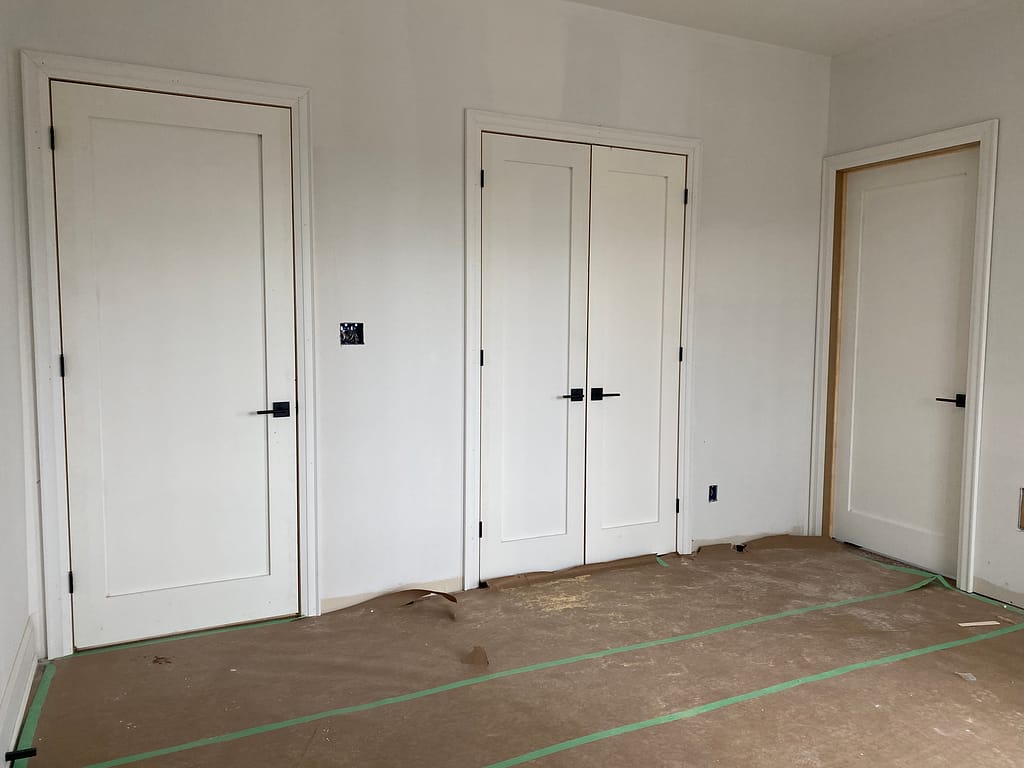
Some solid-core doors have moulded composite faces over a dense particleboard or engineered core. In these doors, the visible panel design may be formed into the door skin rather than constructed as a separate panel.
Other Shaker doors use a stile-and-rail design. The thicker vertical and horizontal sections form the structure around one or more thinner MDF centre panels.
This means a one-panel or two-panel solid-core Shaker door may not have the same thickness and density across every part of its surface.
I have handled and prepared many of these doors on site. The outer stiles and rails can feel extremely substantial, while the recessed centre panel is visibly thinner. That does not make the door hollow-core, but it does mean the phrase “solid core” should not be interpreted too literally.
A Shaker door can still reduce more sound than a basic hollow-core door. It simply should not be confused with a tested acoustic door assembly.
Is the Thinner Shaker Panel a Weak Point?
Potentially, yes—but that requires some perspective.
Sound control is strongly affected by mass. A wide, thinner centre panel will not resist sound in exactly the same way as the thicker stiles and rails surrounding it.
However, MDF is still a relatively dense material. Even a thinner MDF panel can be more substantial than the thin skin and mostly empty interior of a typical hollow-core door.
The practical result depends on the complete product:
- the thickness of the centre panel
- the construction of the stiles and rails
- the overall weight of the door
- whether the door is 1⅜ or 1¾ inches thick
- the type of core used
- the size and number of panels
- whether that specific product has been acoustically tested
Without a published STC rating for the exact door model, no installer or retailer should promise a specific level of sound reduction.
The honest expectation is simpler: a well-made solid-core Shaker door should generally provide better room-to-room sound control than a comparable hollow-core door, but it is not a substitute for a purpose-built acoustic door.
Is a Two-Panel Door Quieter Than a One-Panel Door?
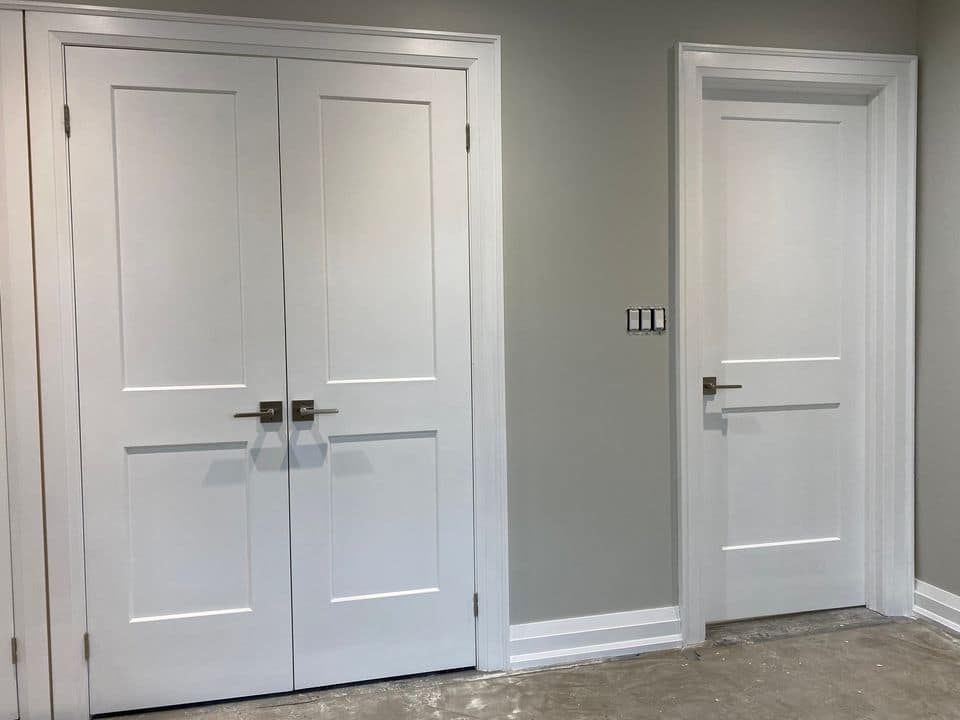
Not necessarily.
A two-panel door has an additional horizontal rail across its structure. In theory, this can change its stiffness, mass distribution and the amount of thinner panel area.
But that does not prove that every two-panel door will block more sound than every one-panel door.
The construction varies too much between manufacturers. One company may use thicker panels, denser engineered components or a different core from another company.
In a real home, the difference between one-panel and two-panel Shaker designs is usually less important than:
- the overall construction and weight
- the gap under the door
- the fit against the door stop
- the reveal around the slab
- the latch and strike adjustment
- the wall construction around the opening
Choose the panel layout primarily for the style of the home. If sound control is a major requirement, compare tested product information instead of relying only on the number of panels.
The Largest Sound Leak May Be Under the Door
Sound does not have to pass directly through the slab.
It can travel around it.
The gap beneath an interior door is often the largest open path between two rooms. Even a heavy solid-core door will have limited effect if there is a large clearance above the flooring.
Some bottom clearance is necessary. The door must swing without rubbing the floor, carpet or transition. Homes may also depend on that opening for air movement when a room does not have a dedicated return-air path.
This creates a trade-off.
Reducing the bottom gap may improve privacy, but making it too tight can cause the door to rub or interfere with the home’s airflow. Before adding a door sweep, automatic door bottom or threshold, the HVAC requirements and floor conditions should be considered.
The goal should not be to make the gap as small as physically possible. It should be to use an appropriate, consistent clearance for that particular room and flooring.
Small Gaps Around the Door Also Matter
Every interior door needs a small reveal between the slab and jamb so it can operate.
If that reveal is excessively wide or inconsistent, sound has a clearer path around the door. If it is too tight, the door may rub after painting or during seasonal movement.
The fit has to balance sound control with reliable operation.
This is one reason proper interior door installation and replacement matters. The carpenter is not only hanging a heavy slab. The jamb, hinges, floor, latch, strike plate, clearances and door stop all have to work together.
A solid-core door may also require better hinge and jamb support than the hollow-core door it replaces. Before keeping an existing frame, it should be checked to make sure it is straight, secure and strong enough for the additional weight. Our guide to replacing interior doors without replacing the frame explains that decision in more detail.
Door Stop Adjustment Is Part of the Installation
The door stop is the narrow trim attached to the jamb that the closed door rests against.
It may look like a simple finishing detail, but its position affects how the door closes, how securely the latch holds it and how much open space remains around the slab.
When I am also installing the handle and latch hardware, I prefer to complete that hardware before making the final door stop adjustment.
There is a practical reason for that sequence.
Once the latch and strike plate are working, I can close the door into its actual resting position. The stop can then be adjusted so the closed door meets it consistently instead of touching at only one point while leaving a slight gap somewhere else.
Along the latch side, the goal is for the door to meet the stop evenly from top to bottom when fully closed. The head stop should also sit cleanly against the door without forcing it out of position.
The hinge side is slightly different.
A very small amount of clearance is needed because the door edge travels through an arc as it swings. If the hinge-side stop is set too tightly, the door can contact it before fully closing. The stop then begins to push against the door rather than simply receiving it.
Paint thickness must also be considered. A gap that is already too tight before painting may become a rubbing point after the door and stop receive their finish coats.
This is not a large visible opening. It is a small working allowance that helps the door swing freely while still closing cleanly.
What If the Hardware Is Installed Later?
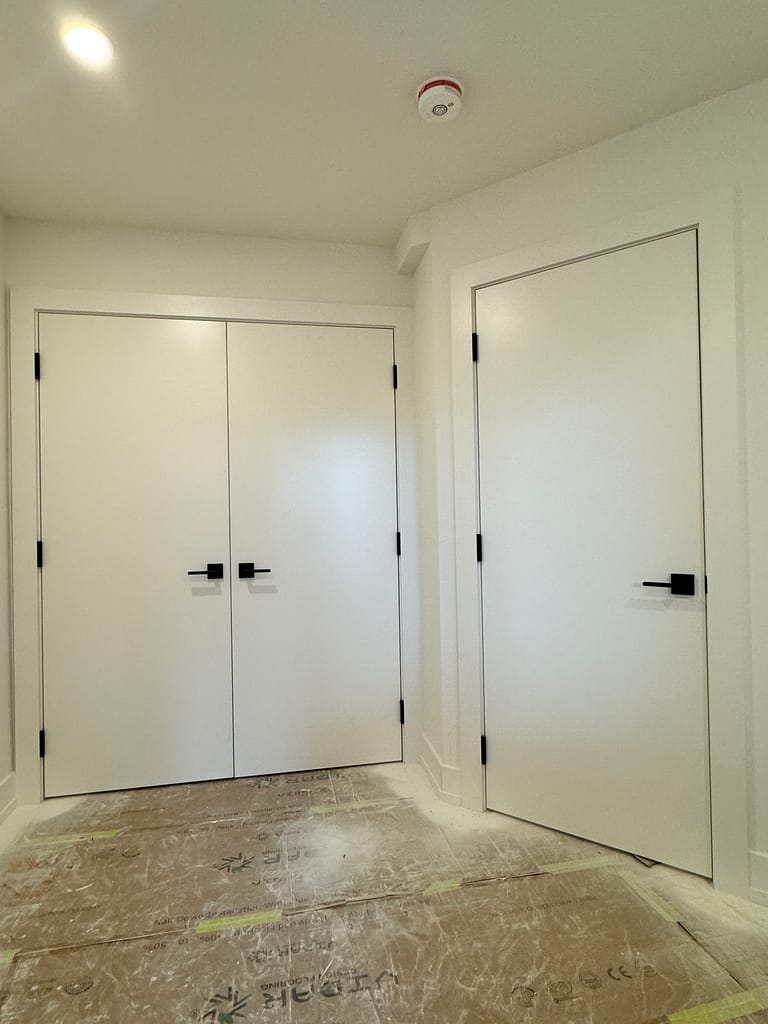
Sometimes Wood Job installs the doors while the homeowner, painter or another contractor plans to install the handles afterward.
The door stop can still be fitted and adjusted during the installation. The door can be held in its proper closed position and the stop can be set for consistent contact.
However, the final latch and strike adjustment should be checked once the hardware is installed.
The strike plate usually allows a small amount of adjustment. Moving it slightly inward or outward changes where the latch holds the closed door.
The final position should allow the latch to catch securely while keeping the face of the door properly seated against the stop. If the strike holds the door too far away, the door may move or rattle. If it pulls the door too tightly, it can make the handle unnecessarily difficult to operate.
This is a very small adjustment, but small adjustments are often what separate a door that merely hangs from one that closes quietly and feels settled in the opening.
Can Weatherstripping Make an Interior Door Quieter?
Perimeter seals can reduce the amount of sound passing through the gaps around a door.
They are commonly used with purpose-built acoustic doors, but they can also help in home offices, bedrooms, music rooms or other spaces where privacy matters.
However, ordinary exterior weatherstripping is not always attractive or suitable for an interior opening. A seal that is too thick can prevent the latch from working properly or make the door feel difficult to close.
If stronger sound control is required, the opening should be treated as a complete system:
- a suitably heavy door
- a solid and properly installed jamb
- controlled reveals
- acoustic perimeter seals
- an appropriate door bottom
- correctly adjusted hardware
- suitable wall construction
At that point, the project is moving beyond a normal interior door upgrade and toward an acoustic assembly.
What Solid-Core Doors Can—and Cannot—Fix
Solid-core doors can help with normal room-to-room privacy. They are particularly useful for bedrooms, bathrooms and home offices.
They cannot correct every noise problem.
Sound may also travel through:
- lightweight partition walls
- electrical outlets
- HVAC ducts
- shared floor or ceiling cavities
- gaps beneath baseboards
- openings above ceilings
- poorly insulated framing cavities
If the wall itself performs poorly, changing only the door may produce a smaller improvement than expected.
The type of noise matters as well. Speech and normal household activity are easier to reduce than heavy bass, impact noise or mechanical vibration.
A solid-core door should therefore be viewed as one practical improvement, not a complete soundproofing system.
Are Solid-Core Doors Worth the Upgrade?
For many homeowners, yes.
Solid-core doors can provide:
- better room-to-room privacy
- a heavier, more stable feel
- less hollow resonance
- improved durability
- stronger support for quality hardware
- a more substantial finished opening
They are often a sensible upgrade when replacing several older builder-grade doors, especially if the project already includes new hardware, casing or jamb work.
They do cost more and take more effort to handle and install. The existing hinges and jambs may also need attention because of the additional weight.
Homeowners planning a larger replacement can review the 2026 Ontario interior door installation cost guide before requesting a project estimate.
The Honest Answer
Will solid-core interior doors make your home quieter?
Usually, yes.
The difference can be worthwhile, particularly when replacing lightweight hollow-core doors in bedrooms, bathrooms or home offices.
But the word “solid” does not guarantee soundproofing. Shaker doors may contain thinner centre panels. Sound can travel under and around the slab. A poorly adjusted latch or door stop can leave gaps even when the door itself is heavy.
The strongest result comes from treating the door as a complete working opening—not simply purchasing a heavier slab.
If you are considering solid-core door replacement, Wood Job can review the existing jambs, door sizes, flooring clearance, hardware and installation conditions. Clear photographs, the number of doors, the project city and the door style you are considering are enough to begin a rough estimate conversation.
Solid-Core Interior Door FAQs
Do solid-core interior doors reduce noise?
Yes. Their additional weight and density generally reduce more room-to-room sound than lightweight hollow-core doors. The improvement also depends on the gaps, bottom clearance, jamb and installation.
Are solid-core doors soundproof?
No. A normal residential solid-core door is not automatically a soundproof or acoustically rated door. True sound control usually requires a tested door assembly, perimeter seals and an acoustic door bottom.
Are solid-core Shaker doors completely solid?
Not always. Construction varies. Some have dense cores beneath moulded faces, while stile-and-rail Shaker doors may have thicker engineered stiles and rails surrounding thinner MDF panels.
Does the gap under an interior door affect noise?
Yes. The bottom clearance can be one of the largest paths for sound. However, reducing it must be balanced with flooring clearance and the room’s ventilation requirements.
Should the door stop touch the entire closed door?
The latch side and head stop should meet the closed door consistently. A very small working allowance is normally left at the hinge side so the swinging door does not rub or bind, particularly after painting.
Can I add weatherstripping to a bedroom door?
A suitable perimeter seal can reduce sound leakage, but overly thick weatherstripping may interfere with closing and latching. For significant sound control, the door, seals, bottom clearance and ventilation should be considered together.




