
Basement doors are often planned too late.
The framing is complete. The drywall is finished. Flooring may already be installed. Then someone measures the visible opening, finds a standard-looking door online and orders a pre-hung package.
That can work when the opening has enough height and the complete door unit suits the wall.
But many basement openings are not standard.
A beam, bulkhead, duct, stair structure or low ceiling may reduce the available height. The floor may rise toward one side. The opening may be wide enough at the bottom but tighter at the header. One wall may be thicker than the other. The framing behind apparently straight drywall may be twisted.
In those conditions, the question is not simply:
Can a standard door be cut shorter?
The better question is:
Which door system gives the carpenter enough control to create a properly fitted and visually balanced opening?
Sometimes the right answer is a custom-sized pre-hung unit.
Sometimes it is a standard pre-hung unit with modest adjustment.
Sometimes it is a plain slab fitted into a custom jamb.
And for very small storage openings, the best answer may be a purpose-built MDF door rather than a full-size interior door product.
At Wood Job Finish Carpentry, I do not begin with the assumption that a slab is always better or that a pre-hung door is always easier.
I begin with the opening.
★★★★★
76 Google Reviews.
Earned One Job at a Time.
Real projects. Real homes. Real customers.
Wood Job Finish Carpentry is an owner-led finish carpentry business installing interior doors in Oakville, Milton, Mississauga, Burlington, Cambridge, Guelph, Kitchener, Hamilton, Vaughan, Toronto and surrounding areas.
The Short Answer
A custom-fitted slab can work better than a standard pre-hung package when:
- The basement opening is substantially lower than a normal interior doorway
- The hinge positions need to be planned after the final door height is known
- A factory panel layout would become badly compressed after trimming
- The handle position needs to be reconsidered
- The jamb has to be built separately for an uneven or non-standard wall
- The casing and baseboard conditions require a custom approach
- A plain slab can be resized and detailed to match nearby doors
- Heavy modification would remove most of the convenience of buying pre-hung
A pre-hung unit can still be the better choice when:
- The opening has sufficient height
- A correctly sized unit can be ordered
- The old jamb is damaged or missing
- The full opening, casing and trim are already being replaced
- The factory hinge and hardware layout suits the finished dimensions
- Only modest fitting is required
The right product is the one that serves the opening.
The opening should not be forced to serve the product.
For the broader differences between the two systems, read Slab Door vs Pre-Hung Door: Which One Do You Need?.
Why Basement Door Openings Become Short
Low basement doors are not necessarily the result of one mistake.
Basements have to work around the structure and mechanical systems of the house.
Available door height may be affected by:
- Structural beams
- HVAC ductwork
- Bulkheads
- Plumbing
- Stair framing
- Low ceilings
- Uneven concrete floors
- New subfloor and finished flooring
- Previous basement renovations
- Openings created after the original house was built
- Mechanical and utility-room access requirements
Sometimes the rough opening was always low.
Sometimes the new floor reduces a previously workable height.
Sometimes a bulkhead is added after the door framing.
Sometimes the drywall opening looks reasonably straight while the framing behind it is not.
These conditions should be discovered before the doors are ordered.
Our guide to measuring interior doors for replacement explains why width and height should be checked at more than one location.
A Pre-Hung Door Is Not a Bad Product
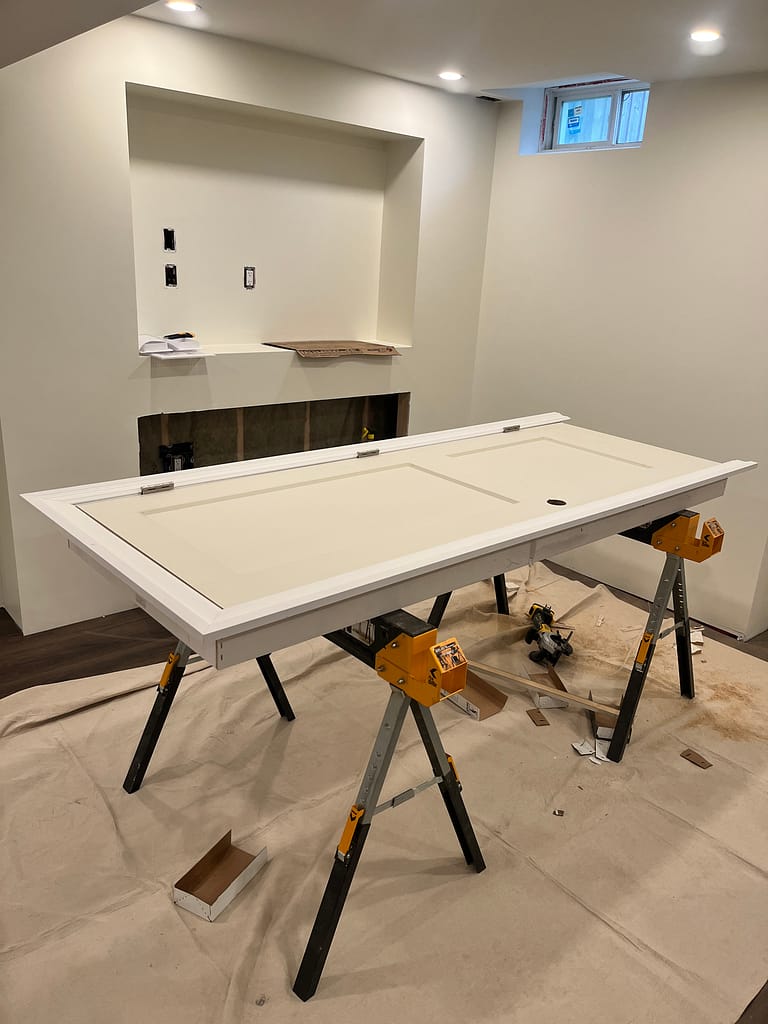
A pre-hung door is a useful system.
It normally arrives with the slab already mounted in a jamb. The hinges, door stop and much of the basic preparation are already established.
For a suitable opening, this can create an efficient starting point.
A pre-hung unit is often practical when:
- The existing jamb needs to be removed
- The opening is reasonably standard
- The wall thickness matches an available jamb
- The factory door height works
- The hinge layout can remain as supplied
- The casing is being replaced
- The door swing and hardware preparation are already confirmed
The problem is not that the door comes pre-hung.
The problem begins when a unit prepared around a standard door height has to be heavily dismantled and rebuilt to fit an unusually short opening.
At that point, the homeowner may be paying for factory preparation that the carpenter cannot use.
When the Advantage of Pre-Hung Begins to Disappear
Suppose a pre-hung unit arrives with:
- A factory-sized slab
- A completed jamb
- Three established hinge positions
- Door stops already installed
- A factory handle bore
- A fixed panel layout
If the opening is only slightly shorter, the unit may still be adjustable without causing a serious visual or functional problem.
But if several inches must be removed, the carpenter may have to reconsider nearly every part of the package:
- Where the door should be cut
- Whether the door construction allows that much trimming
- Whether the bottom support remains intact
- Whether the lower rail will look too narrow
- Whether the hinge positions still make sense
- Whether the bottom hinge is left visually crowded near the floor
- Whether the jamb legs must be shortened
- Whether the door stops need to be removed and reset
- Whether the handle bore remains in the right place
- Whether the strike plate can still be positioned properly
- Whether the casing will frame the shortened opening well
The pre-hung unit may still be usable.
But it is no longer providing the simple installation advantage for which it was purchased.
The carpenter is now dismantling, modifying and rebuilding a factory assembly.
A plain slab and independently prepared jamb may provide more control from the beginning.
What a Custom-Fitted Slab Gives the Carpenter Control Over
A slab door is only the door panel.
It does not arrive committed to a particular jamb or hinge layout unless factory preparation has been ordered.
That can be valuable in a low basement opening.
Once the actual finished opening is understood, the carpenter can plan:
- Final slab height
- Top and bottom clearances
- Hinge quantity and positions
- Handle-bore position
- Latch and strike height
- Jamb height and depth
- Door-stop location
- Casing layout
- Panel proportions
- Relationship to nearby doors
- Baseboard and flooring transitions
This does not mean the work is automatically simpler.
A slab still has to be sized, bevelled where required, mortised for hinges, bored for hardware, fitted into the jamb and adjusted for a clean reveal.
The advantage is control, not the absence of labour.
“Custom Slab” Does Not Always Mean a Door Made From Scratch
There are several ways a custom slab solution may be created.
A stock slab fitted to the opening
A standard plain or panelled slab may be resized within the limits of its construction and fitted to a new or existing jamb.
A plain slab modified and detailed on site
A flush slab can sometimes be resized first and then finished with applied MDF or moulding details so it relates visually to the other doors in the basement.
A special-order slab made to the required height
Some suppliers can provide non-standard door sizes. This may preserve a factory panel design more successfully than aggressively cutting a standard product.
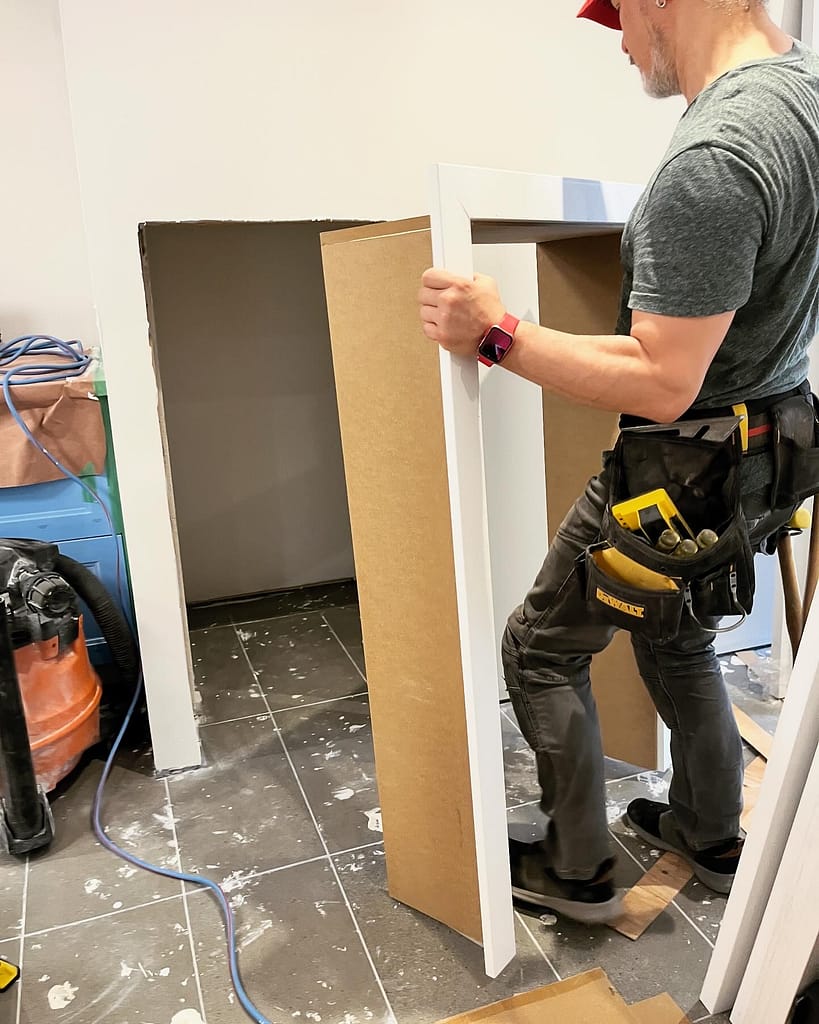
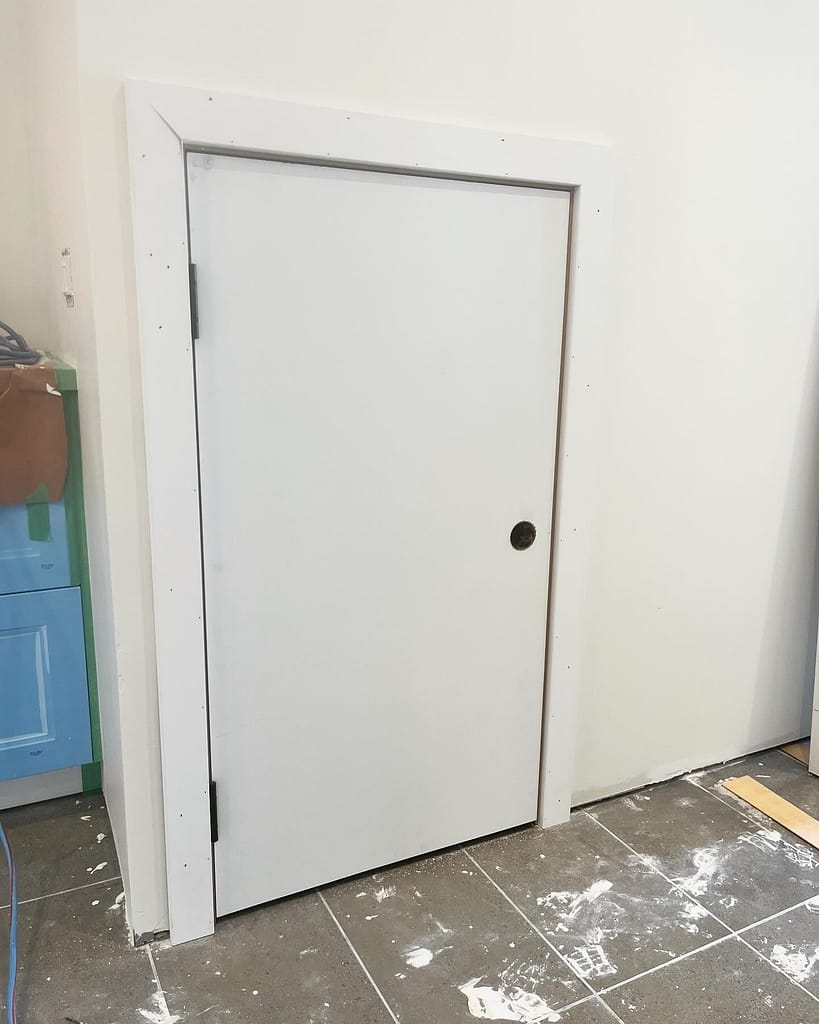
A purpose-built MDF door
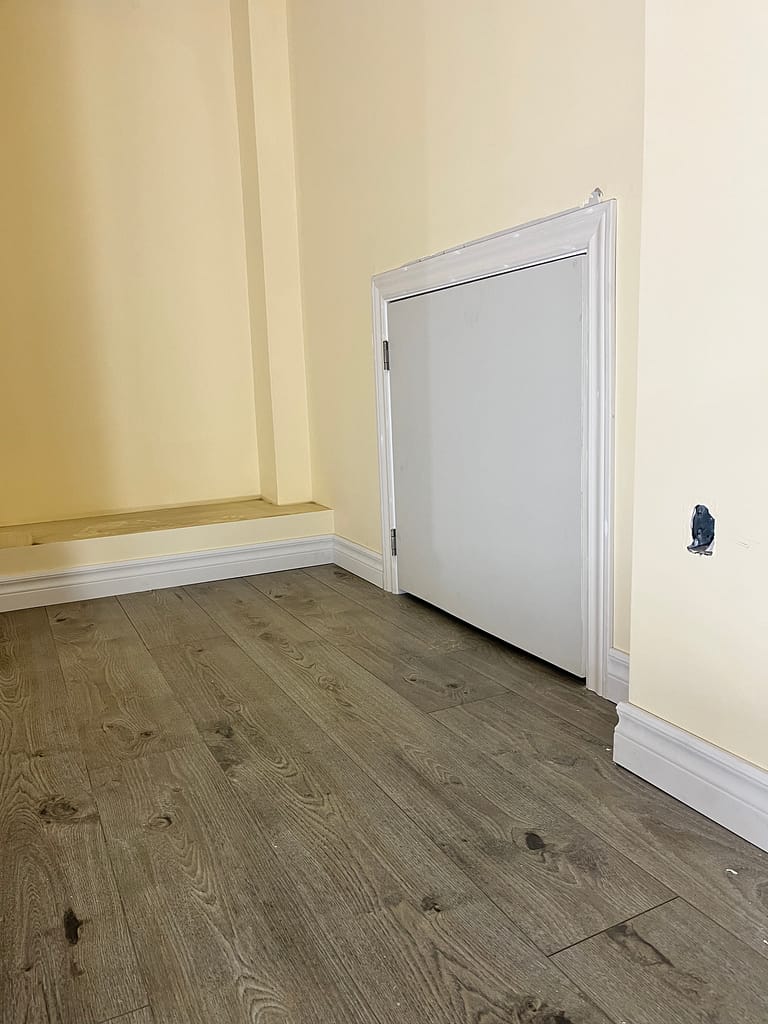
For a very low storage or under-stair opening, a full interior slab may not be the right starting point. A simple custom MDF door can be sized and proportioned for the actual space.
These are different solutions.
The correct one depends on the opening, door function, material, desired appearance and budget.
The Door Construction Decides How Much Can Be Removed
A carpenter should never assume that every door can be shortened by the same amount.
A hollow-core door usually contains a light internal core with solid blocking around its perimeter.
If too much is removed from the bottom, the cut can pass through the lower support and expose the hollow interior.
In some suitable doors, the bottom support block can be separated from the offcut, cleaned and reinstalled inside the newly cut bottom edge.
That restores support to the shortened door and helps close the hollow core against damage and moisture.
But this should not be treated as permission to cut any hollow-core door by any amount.
The carpenter still needs to consider:
- The manufacturer’s permitted trimming allowance
- The depth of the original bottom blocking
- The construction of the slab
- Whether the support can be reinstalled properly
- Whether the panel proportions will survive the cut
- Whether the warranty or factory finish will be affected
- Whether ordering a different product would make more sense
Solid-core doors present a different set of conditions.
They may offer more material through the body, but they are substantially heavier. The jamb, hinges, screws and rough framing all need to support that weight properly.
The fact that a door can be cut does not automatically mean it is the correct door for the opening.
Panel Proportions Can Become the Real Problem
A door can operate perfectly and still look wrong.
This happens often when a standard moulded panel door is shortened heavily from one end.
Door designs are proportioned around a particular slab height.
The top rail, bottom rail, centre rail and panels have a visual relationship. When several inches are removed from the bottom, that relationship changes.
The bottom rail may become noticeably narrow.
A lower panel may appear compressed.
On a two-panel or six-panel door, the entire face may look as though it has dropped toward the floor.
This is not a hinge problem.
It is not something casing can correct.
It is a door-selection problem.
Plain flush slabs are more flexible
A plain slab has no factory panel arrangement to distort.
That makes it a useful starting point when substantial resizing is unavoidable.
One-panel doors can be more forgiving
A simple one-panel style may tolerate moderate adjustment better than a busy multi-panel design, although the actual construction and trimming allowance still matter.
Applied detail can restore visual consistency
After a plain slab has been fitted, applied MDF or moulding can sometimes create a panel detail scaled to the shorter door.
Wood Job has used this approach in real projects. A plain slab can become the stable base, while the applied detail is proportioned for the finished height instead of copied blindly from a standard 80-inch door.
The same principle was used in a Vaughan designer-led project where plain slab doors were customized with applied moulding to achieve a specific door design that was not practical to source within the project timeline.
A plain door is not always the final design.
Sometimes it is the correct starting material.
Handle Height Must Be Planned Before the Door Is Drilled
Shortening a door changes the relationship between the door bottom, panel layout and handle.
On a standard-height panel door, the handle is usually placed in a visually expected area around the lock rail.
When several inches are removed from the bottom, the lock rail stays where it was manufactured, but the bottom of the door moves upward.
If the new handle bore is placed at the usual distance from the shortened bottom, it may no longer align visually with the lock rail.
If the handle is lowered to stay on the rail, it may feel unusually low compared with the other doors in the home.
There may not be a perfect answer after the wrong product has already been purchased.
That is why the following should be reviewed before drilling:
- Finished slab height
- Panel design
- Lock-rail location
- Handle height from the finished floor
- Handle height on nearby doors
- Strike-plate position
- Door function
- Homeowner preference
This exact problem is explained in Why Door Handle Height Can Look Wrong on Short Basement Doors.
A pre-bored door removes much of that flexibility.
Once the factory hole exists, the carpenter has to work around it.
Hinge Placement Should Be Planned for the Finished Door
Hinge locations should not be treated as a decorative afterthought.
They support the door and affect how the slab sits in the jamb.
When a standard pre-hung door is shortened heavily, retaining the original hinge locations can leave the bottom hinge visually crowded near the floor.
Simply cutting from one end can also make the overall hinge layout feel uneven on the shorter slab.
With a plain, unmachined slab, hinge locations can be planned after the finished door height is known.
The carpenter can consider:
- Door height
- Door weight
- Number of hinges
- Jamb material
- Hinge size
- Available framing support
- Visual spacing
- Hardware position
This is particularly important with solid-core doors.
A heavy slab should not be hung from a weak jamb with unsuitable hinges simply because those components arrived together in a package.
The Jamb May Be More Custom Than the Door
In many basement projects, the door slab receives most of the attention.
But the jamb can be the more complicated part.
Basement walls may have:
- Non-standard thickness
- Different depths on each side
- Twisted framing
- Oversized openings
- Headers wider than the wall below
- Drywall proud of the framing
- Tile or wall paneling on one side
- Limited space for shimming
A standard pre-hung jamb may be too narrow, too wide or built for a more consistent opening.
In those cases, building or fitting the jamb separately can produce a cleaner result.
Wood Job encountered this in a Milton basement unit requiring six doors and custom jambs. The openings were oversized and inconsistent, so standard jamb material could not simply be installed and expected to fit.
Each opening had to be measured and treated individually.
That project is a useful reminder:
Sometimes the jamb is the job.
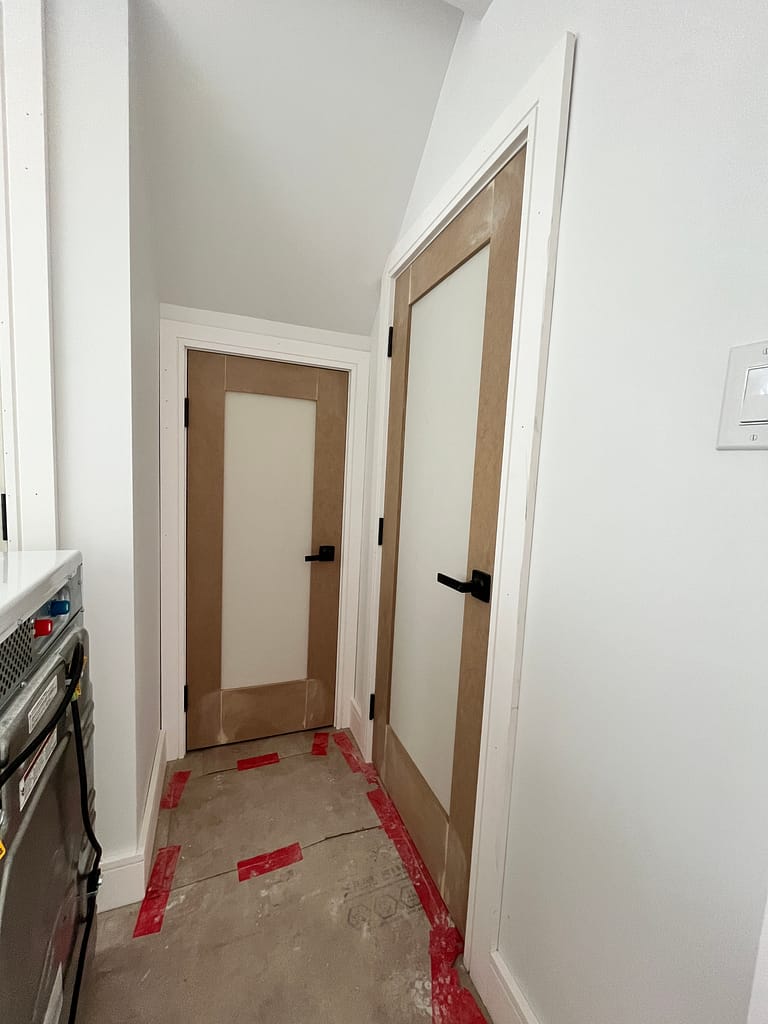
Real Wood Job Project: Two Short Basement Openings in Burlington
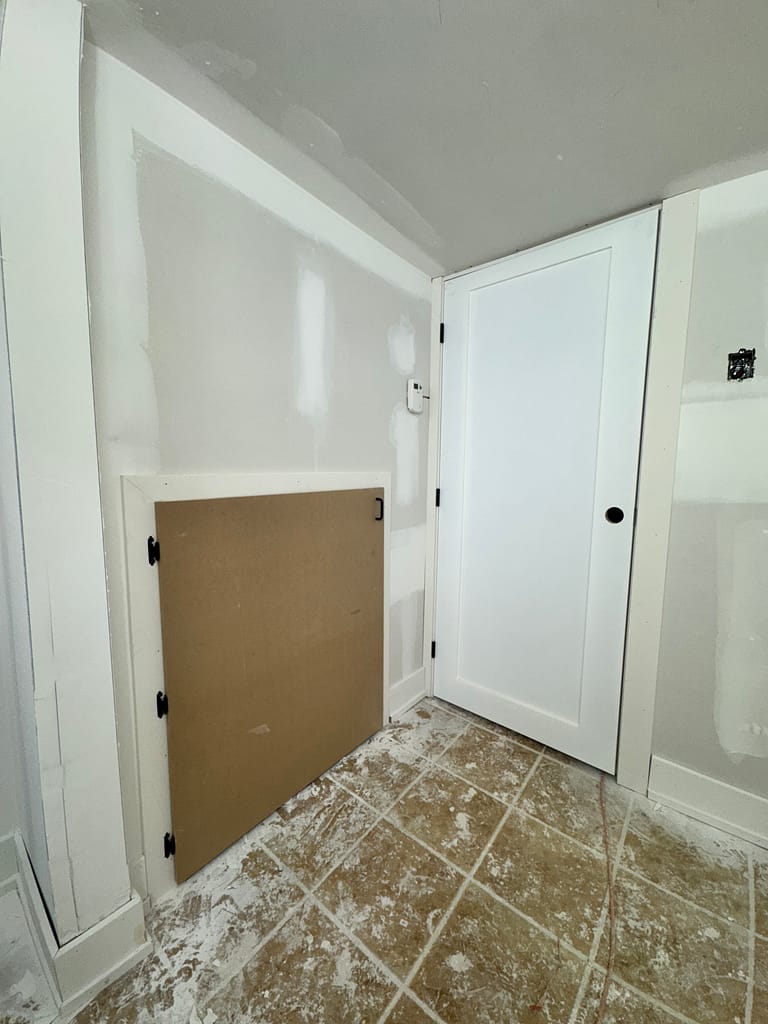
A Burlington homeowner contacted Wood Job about two unfinished basement door openings.
One was for a washroom. The other separated the finished basement from the laundry and utility area beside the stairs.
Both openings were lower than the height commonly associated with standard interior-door packages.
They also had different conditions.
The washroom opening was particularly short.
The laundry-room opening was taller but sat beside the stairs, beneath a low ceiling condition, with framing that required careful jamb positioning and shimming.
This was not a case where two matching boxes could simply be ordered and inserted.
The work required the openings, jambs, slabs, hinges, casing, hardware and flooring transition to be planned together.
You can see the completed project in Basement Door Installation in Burlington.
What matters about that project is not that every basement should receive the same product.
It is that the product decisions were made around the real openings.
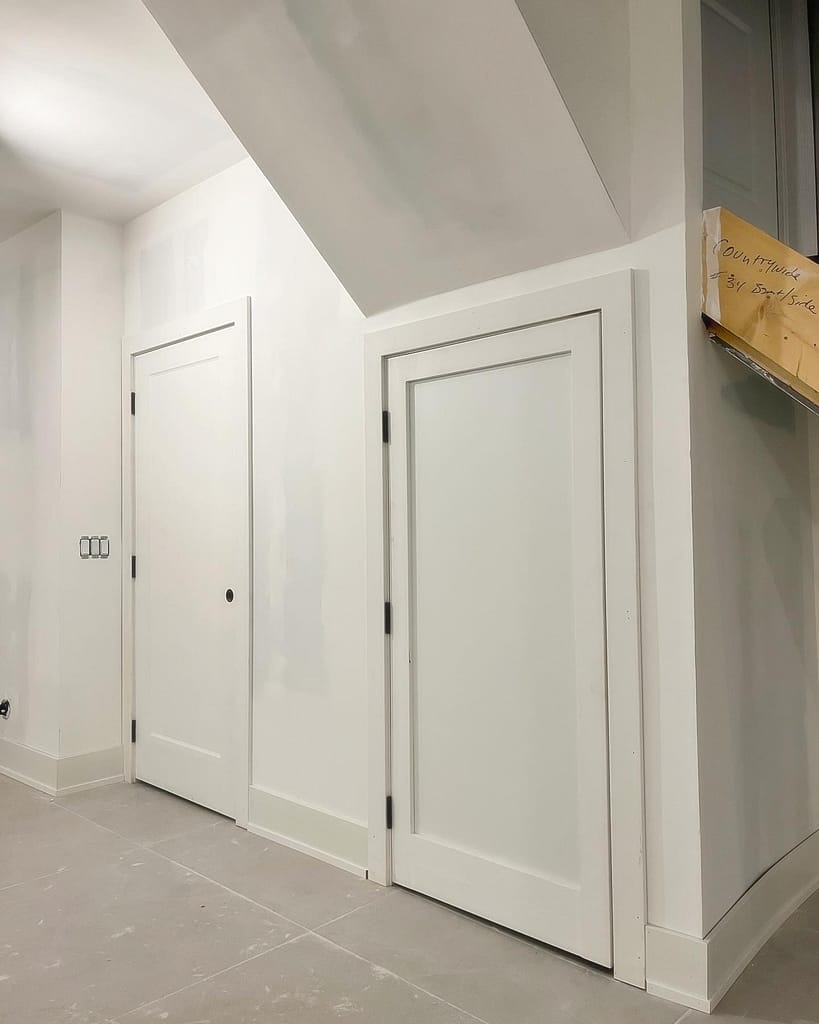
Real Wood Job Approach: Matching a Short Door to Nearby Doors
In another basement project, one opening was lower than the other door openings nearby.
Using a standard pre-hung panel door and cutting it heavily would have compressed the lower part of the design.
Wood Job instead used a plain slab as the starting point.
The slab could be fitted to the actual opening first. Custom MDF detailing was then added so the shorter door could relate visually to the one-panel doors around it.
The goal was not to disguise the opening or pretend the door was full height.
The goal was to make the shorter door look intentional.
That is one of the advantages of working from a plain slab:
The proportions can be designed after the real finished size is known.
Under-Stair and Storage Doors Need Their Own Logic
A small under-stair opening does not always need a shortened version of a bedroom door.
Trying to make a tiny storage access door imitate a full-size interior door can produce strange proportions and unnecessary hardware.
For very low openings, the better solution may be:
- A modified flush slab
- A custom MDF door
- A simple access-style door
- Applied detailing that relates to nearby trim
- A custom jamb and casing package
- A door designed primarily around access and swing clearance
Wood Job’s project collection on custom basement storage doors for under-stair and low openings shows several ways these spaces can be handled.
A small door can still feel properly finished.
It simply has to be designed for the job it is doing.
Casing and Baseboards Still Matter Around a Short Door
A shortened door does not exist by itself.
Casing has to frame the opening.
Baseboard has to terminate into the casing.
The door needs enough clearance over the finished flooring.
A bulkhead, stair angle or adjacent wall may limit the casing width.
The carpenter may need to consider:
- Whether the casing can remain full width
- Whether the header casing will fit below the ceiling or bulkhead
- How the baseboard meets a shorter casing leg
- Whether shoe moulding continues through the opening
- Whether the casing profile matches the other basement doors
- Whether the short door should visually disappear or become a deliberate feature
This is why Wood Job’s interior door installation service treats the door, jamb, hinges, hardware, casing and surrounding trim as one finished opening.
A door can close properly and still look unfinished if the trim around it was not planned.
When a Pre-Hung Unit Is Still the Better Choice
This article should not be read as an argument against every pre-hung basement door.
A pre-hung unit may still be the cleanest answer when:
- The opening can accept a standard or available custom height
- The existing jamb is missing or damaged
- The old casing is already being removed
- The wall depth matches the jamb
- The factory panel and hinge layout remain proportionate
- The door only needs minor adjustment
- The supplier can provide the correct custom-sized package
- The complete door and jamb need to be reset
A custom-sized pre-hung unit can be an excellent solution when it is ordered for the actual opening.
The warning is against buying a standard package first and expecting the carpenter to discover a clean solution after delivery.
Before purchasing, review 12 details your installer should confirm before you order interior doors.
When a Custom-Fitted Slab Is the Better Choice
A slab solution becomes especially useful when:
- The opening is too short for an available standard package
- The jamb needs to be built independently
- The door needs substantial resizing
- The hinge layout should be established after resizing
- The handle has not yet been bored
- A plain slab avoids damaging a factory panel layout
- Applied detail can be proportioned to the shorter door
- The surrounding trim requires custom fitting
- Several nearby doors must still look visually related
Even then, the slab should be selected carefully.
The carpenter still has to understand:
- Door construction
- Trimming limits
- Final weight
- Jamb strength
- Hardware
- Panel or applied-detail layout
- Finished-floor clearance
- Paint and finishing sequence
A slab gives the carpenter control.
That control still has to be used responsibly.
What Wood Job Checks Before Recommending a Basement Door
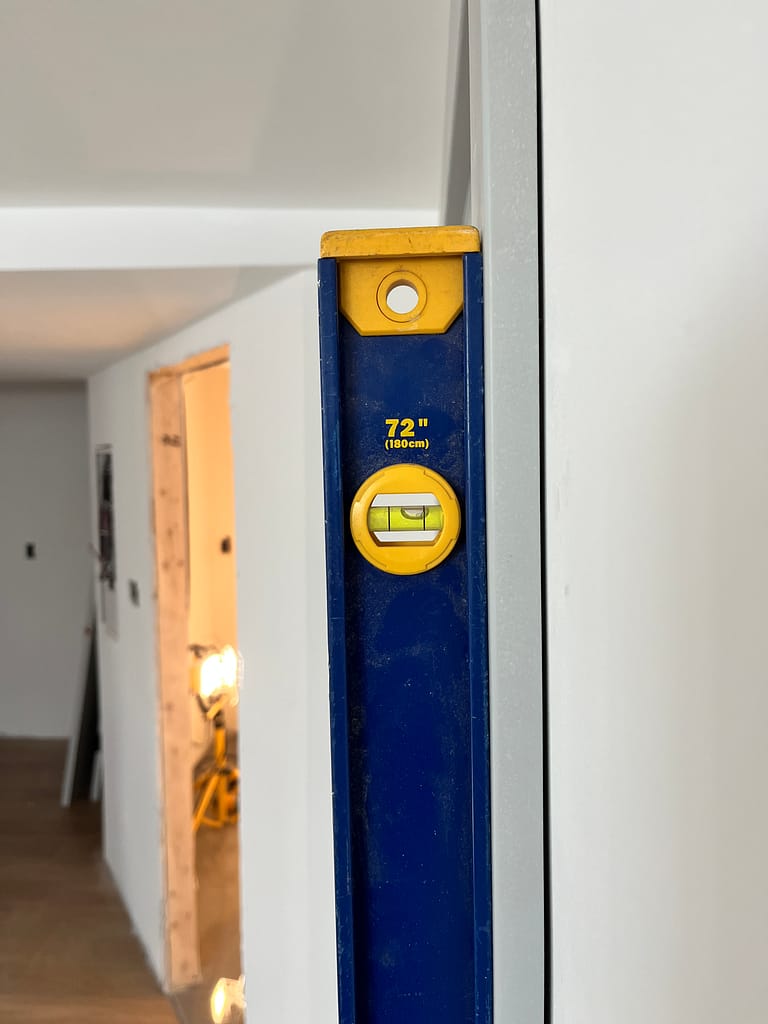
Before I recommend a slab, pre-hung unit or custom-built door, I look at more than the visible height.
At Wood Job, the review normally includes:
- Opening width at the top, middle and bottom
- Opening height at both sides
- Finished-floor height
- Header and bulkhead position
- Wall thickness
- Available jamb depth
- Stud alignment
- Shimming space
- Door swing
- Required privacy or passage hardware
- Door weight
- Hinge support
- Panel proportions
- Handle location
- Casing width
- Baseboard transition
- Relationship to nearby doors
- Whether material has already been purchased
Photos and rough measurements are useful at the beginning.
But heavily modified doors, inconsistent framing or custom jamb work may still require a walkthrough.
Why Owner-Led Finish Carpentry Matters Here
A short basement door creates decisions that are difficult to settle from a product description.
Should the door be plain or panelled?
Can the slab be shortened without weakening it?
Should the bottom support be rebuilt?
Where should the hinges sit?
Will the handle still relate to the panel?
Does the jamb need to be custom?
How should the header casing fit below the bulkhead?
Those decisions happen close to the work.
Wood Job Finish Carpentry is intentionally owner-led. Clients work directly with Jack Cenk Ozer, the person measuring, preparing, fitting and taking responsibility for the finished result.
The installation is not sold by one person and handed to an unknown subcontractor.
That matters on non-standard openings because the original measuring decision and the final fitting decision need to remain connected.
You can read more about that approach in Why It Matters Who Actually Shows Up to Do the Finish Carpentry.
Plan the Door Before Buying the Door
The most expensive mistake is often not the carpenter’s cut.
It is the product decision made before the opening was understood.
Before ordering basement doors, confirm:
- Final opening height
- Final floor height
- Wall thickness
- Slab construction
- Available jamb size
- Door style
- Trimming limits
- Hinge preparation
- Handle bore
- Hardware function
- Casing space
- Whether the door should match nearby openings
The homeowner can choose the look.
The supplier can explain the product.
The carpenter should connect that product to the actual opening.
A few measurements and photographs before ordering can prevent a room full of unsuitable doors from arriving at the house.
Planning Short Basement Doors?
Wood Job Finish Carpentry provides owner-led basement door installation, slab fitting, pre-hung installation, custom jambs, casing, hardware preparation and custom solutions for non-standard openings.
To begin, send:
- Project city
- Wide photographs of each opening
- Opening width and height
- Photographs of the ceiling, bulkhead or stairs above
- Finished-floor information
- Door style being considered
- Number of doors
- Whether the material has already been purchased
- Photos of nearby doors, casing and baseboards
Use the photo-based estimate page to send the information.
Wood Job can review whether a standard pre-hung unit, custom-sized pre-hung unit, modified slab, custom jamb or purpose-built storage door appears to be the most sensible starting point.
Questions About Short Basement Doors
Can a standard 80-inch interior door be shortened for a basement?
Sometimes, but the amount that can be removed depends on the door’s construction and manufacturer requirements. Heavy trimming may affect the bottom support, panel proportions, handle position and warranty. The door should be reviewed before cutting.
Is a slab door always better than a pre-hung door in a basement?
No. A pre-hung unit can be the better solution when the opening has enough height, the jamb needs replacement and the complete package suits the wall. A slab becomes more useful when the opening requires substantial customization or an independently built jamb.
Can a pre-hung door be cut shorter?
It can sometimes be modified, but substantial shortening may require the slab, jamb, stops, hinges and hardware positions to be reconsidered. Once that amount of rebuilding is required, the original convenience of the pre-hung package may be lost.
What happens when a hollow-core door is cut too short?
The cut may remove the solid blocking at the bottom and expose the hollow core. In some suitable cases, the original bottom support can be removed from the offcut and reinstalled inside the new bottom edge. The door construction and trimming limits must be checked first.
Are plain slab doors better for very short openings?
They can be. A plain slab has no factory panel layout to distort, which gives the carpenter more control over resizing and hardware placement. Applied MDF or moulding detail may later be added if the door needs to relate visually to nearby panel doors.
Why can the handle look wrong after a basement door is shortened?
Shortening the door changes the relationship between the new bottom edge and the original panel layout. A handle bored at a standard height may no longer align visually with the lock rail. Handle placement should be considered before drilling.
Can you order a custom-height pre-hung door?
Some suppliers and manufacturers offer non-standard sizes. Availability, lead time, panel design, jamb depth and factory preparation should be confirmed before ordering. A correctly sized custom pre-hung unit may be preferable to heavily modifying a standard package.
What if the opening is too small for a regular interior door?
A modified plain slab, purpose-built MDF door or access-style door may make more sense. Very low under-stair and storage openings should be designed for their actual function rather than forced to imitate a full-size bedroom door.
Should the finish carpenter measure before the basement doors are ordered?
Yes, especially when the openings are low, inconsistent, out of square or affected by new flooring. The installer should confirm the dimensions, jamb requirements, door construction, hardware and surrounding trim before the final order.
Where does Wood Job install custom basement doors?
Wood Job Finish Carpentry provides owner-led basement door and finish carpentry services in Oakville, Milton, Burlington, Mississauga, Cambridge, Kitchener, Guelph, Hamilton, Vaughan, Toronto and surrounding areas.
Related Wood Job Pages
Why Owner-Led Finish Carpentry Matters
Before hiring a carpenter, it helps to know who will actually show up, take responsibility and handle the details inside your home.
Meet Jack Cenk Ozer
Learn more about the hands-on finish carpenter behind Wood Job Finish Carpentry and the personal craftsmanship behind the business.
Interior Door Installation
Interior doors, door replacement, hardware, hinge alignment, latch fitting, casing and clean door installation.
Finish Trim Carpentry
Door casing, window casing, baseboards, shoe moulding, trim repairs, custom jamb details and renovation finishing.
Photo-Based Rough Estimate
Send photos, measurements, project location and a short description of your small carpentry job.




