
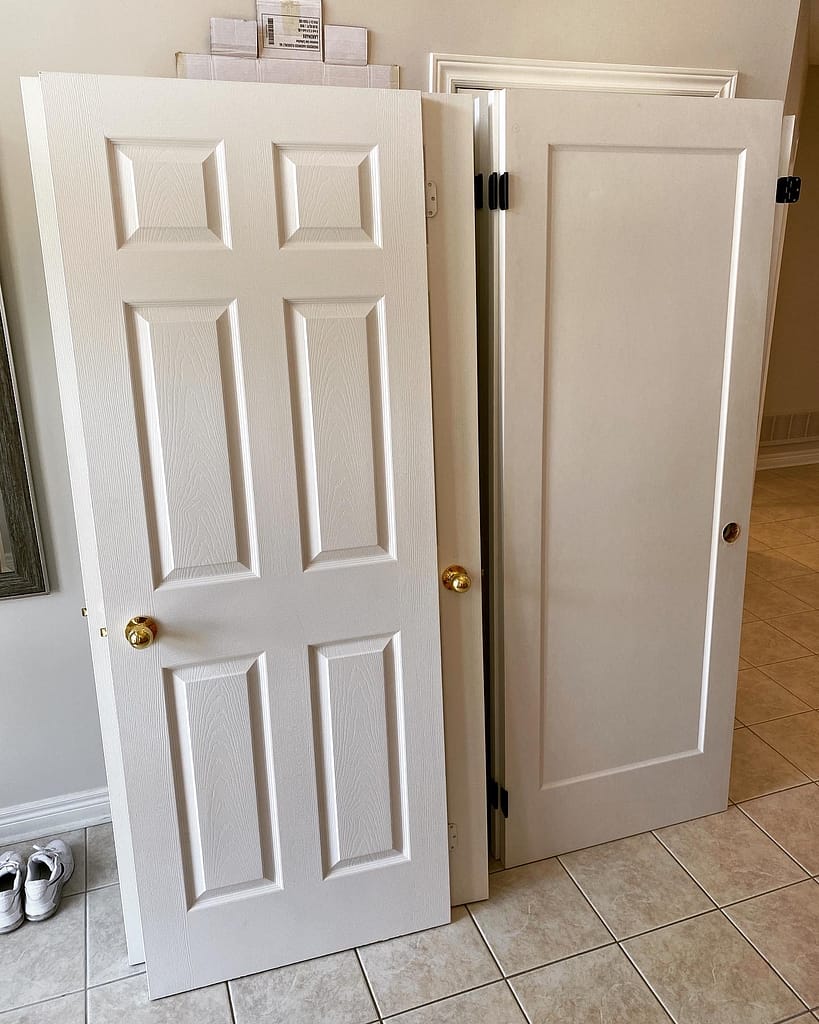
Replacing an interior door may seem simple.
Measure the old door. Buy another door with the same number on the label. Install it in the existing frame.
Sometimes it works that way.
But a door marked as 30 inches wide is not necessarily exactly 30 inches across both faces. A new solid-core door may be thicker than the hollow-core door it is replacing. The old door may have beveled edges while the new one is completely square. Hinge positions, lock preparation, flooring clearance and the location of the door stop can also be different.
These details can turn what looked like a straightforward slab replacement into additional cutting, planing, hinge work and jamb adjustment.
The safest rule is simple:
Do not order a replacement interior door using only its nominal width and height.
Measure the actual door, understand how its edges are prepared and check the existing jamb before purchasing the replacement.
★★★★★
77 Google Reviews.
Earned One Job at a Time.
Real projects. Real homes. Real customers.
Wood Job Finish Carpentry is an owner-led finish carpentry business replacing interior doors in Oakville, Milton, Mississauga, Burlington, Cambridge, Guelph, Kitchener, Hamilton, Vaughan, Toronto and surrounding areas.
Are You Replacing Only the Door or the Entire Door Unit?
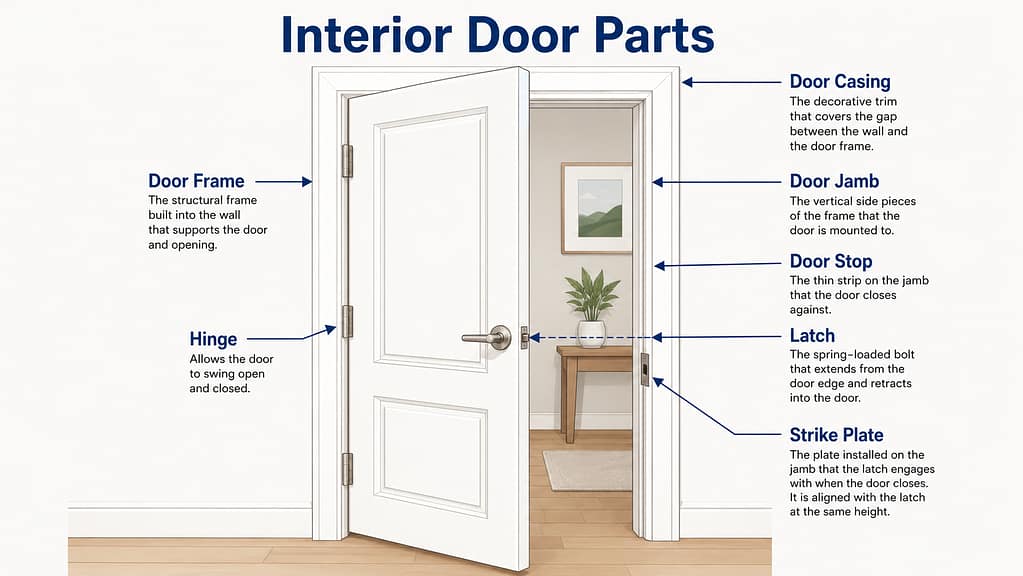
Before taking measurements, determine what kind of replacement you are planning.
A slab door is only the door itself. It does not normally include a jamb, casing, hinges or door stop.
A pre-hung door comes assembled with a new jamb and usually includes hinges and a door stop. Installing one generally involves removing the existing jamb and at least some of the surrounding casing.
If the existing jamb is straight, solid and in good condition, replacing only the slab may be the cleaner option. If the jamb is twisted, damaged, badly painted or out of square, a new pre-hung unit may make more sense.
Our guide to slab doors versus pre-hung doors explains that decision in more detail.
For a slab replacement, measure the existing door itself first.
For a pre-hung replacement, the rough opening, finished wall thickness, jamb depth and swing direction also have to be checked.
Start With the Existing Door—But Only If It Works Properly
An existing door can be the best template for its replacement, but only when the current door fits and operates reasonably well.
Before copying its measurements, check whether it:
- Rubs against the jamb or floor
- Has an unusually large gap along one side
- Swings open or closed by itself
- Needs to be lifted or pushed to latch
- Sits unevenly against the door stop
- Has already been heavily planed or cut
- Has hinges that are loose or badly aligned
If the existing door already has a functional problem, ordering an exact copy of it may reproduce the same problem.
An interior door that rubs or refuses to latch may be telling you something about the jamb, hinges, floor or opening. Our guide to interior doors that rub, stick or will not latch explains what those symptoms can mean.
How to Measure the Width of an Interior Door
Measure the actual door slab, not the distance between the door stops.
Keep the door open and record the width at three locations:
- Near the top
- Through the middle
- Near the bottom
Do not automatically round the measurement to the nearest whole inch.
A door sold as a 30-inch door may not measure exactly 30 inches on every surface. It may have been factory prepared below its nominal size, or it may have been planed during an earlier installation.
There is another detail many homeowners—and some product descriptions—overlook:
The two faces of the door may not be the same width.
Why a 30-Inch Door May Also Measure 29 7/8 Inches
Many builder-grade hollow-core interior doors I encounter have beveled vertical edges.
A bevel is a slight angle cut along the edge of the door. Instead of both faces meeting the edge at a perfect 90-degree angle, one face is slightly wider than the other.
For example, a nominal 30-inch door may measure approximately:
30 inches across one face
29 7/8 inches across the opposite face
Sometimes the difference is closer to 3/16 inch, depending on the product, its preparation and any previous fitting.
This does not necessarily mean the door was manufactured incorrectly. The bevel helps the leading edge clear the jamb as the door moves through its swing.
A door does not travel straight toward the jamb. Its outside edge follows an arc around the hinges. Without enough clearance or a suitable bevel, the leading corner can contact the jamb before the door reaches the closed position.
How to Check for a Beveled Door Edge
Measure the width across both faces of the door.
Then look down the vertical edge from the top. A small square can also make the angle easier to see.
Record:
- The width of the wider face
- The width of the narrower face
- Which face is wider
- Whether the hinge edge, latch edge or both edges are beveled
Do not assume every hollow-core door is beveled or every solid-core door is square. Product lines vary.
The actual door in front of you matters more than the general rule.
Why the Bevel Matters When Upgrading to Solid-Core Doors
A common project is replacing lightweight hollow-core doors with heavier solid-core doors while keeping the existing jambs.
This can be a very good upgrade. Solid-core doors generally feel more substantial and can improve the sense of privacy between rooms.
But the new slab still has to match the existing opening.
Suppose the original hollow-core door has beveled edges, but the new solid-core slab has full square edges and measures exactly 30 inches across both faces.
The new door may fit inside the jamb when held still, yet rub or bind as it swings. The problem becomes more noticeable when the existing opening already has tight clearances or a narrow latch-side gap.
The solid-core door may then need to be resized and beveled before it can operate properly.
That work is possible, but it adds another machining process. It can affect factory primer or finishing, and the amount that can safely be removed depends on the door’s construction and manufacturer instructions.
It is usually better to confirm the edge preparation before ordering several doors.
When speaking with the supplier, ask:
“Is this slab prefit and beveled, or full-size with square edges?”
Also ask for the actual finished width—not only the nominal size shown in the product title.
Retailers such as Home Depot Canada and RONA usually list the nominal width, height, core type and thickness. The edge preparation and exact finished width may still need to be confirmed directly with the supplier or manufacturer.
Measure the Door Height in More Than One Place
Measure the slab itself from its top edge to its bottom edge.
Take measurements along:
- The hinge side
- The centre
- The latch side
A door sold as 80 inches may have been shortened for carpet, hardwood, tile, a sloping floor or a previous renovation.
The bottom may also have been cut at a slight angle to follow an uneven floor. This is common in older homes and basement openings.
Record the current floor clearance separately. Do not include that gap as part of the door height.
Also consider whether the flooring will change. Replacing carpet with hardwood, adding tile or installing new underlayment can change the clearance beneath the door.
A door measured before the flooring is complete may no longer fit once the finished floor is installed.
Check the Door Thickness
Measure the thickness at several points along the vertical edge.
A common residential interior door thickness is 1 3/8 inches. Both hollow-core and solid-core doors are available in this thickness.
However, some heavier solid doors are 1 3/4 inches thick.
That 3/8-inch difference matters.
Replacing a 1 3/8-inch door with a 1 3/4-inch door may require changes to:
- Hinge size or hinge placement
- Hinge mortises
- Fastening and hinge support
- Lock and latch preparation
- Strike alignment
- Door stop position
- Clearances within the jamb
The door stop is the narrow trim piece inside the jamb that the closed door rests against.
In many interior jambs, it is a separate piece that can sometimes be removed and repositioned. Removing it is not always clean. Paint and caulking may hold it in place, and an older MDF or wood stop can split during removal.
Other jambs use an integral or rabbeted stop that cannot simply be moved like a separate trim piece. In those situations, changing the door thickness may make a slab-only replacement impractical.
For a straightforward replacement, matching the existing thickness is usually the cleanest choice.
Measure the Hinges, Not Just the Door
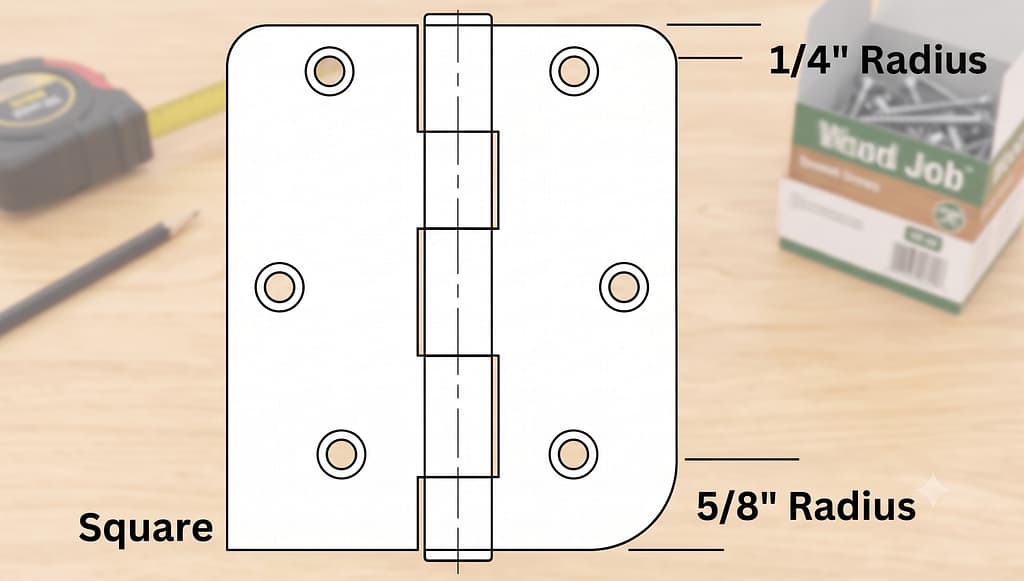
A blank slab can be machined for new hinges, but factory-prepared or pre-mortised slabs need to match the existing jamb closely.
Record:
- Number of hinges
- Hinge height
- Hinge width
- Square or rounded hinge corners
- Note the corners radius: 1/4 or 5/8 inches
- Distance from the top of the door to the top of each hinge
- Distance from the door face to the hinge location
- Hinge condition and screw condition
Measure every hinge individually.
Do not assume the spacing is standard or perfectly equal. Existing jambs may have been prepared by hand, adjusted during a previous repair or built to an older standard.
When upgrading from hollow-core to solid-core doors, the existing hinges and screws also need to be checked. A heavier door makes loose screws, shallow mortises and poor hinge alignment much more noticeable.
Record the Handle and Latch Preparation
If you are purchasing a pre-bored slab, check whether the factory preparation will match the existing jamb.
Measure:
- Distance from the top of the door to the centre of the handle bore
- Bore diameter
- Backset—the distance from the door edge to the centre of the handle bore
- Latch faceplate size
- Latch faceplate shape
- Strike plate location on the jamb
A handle hole that is slightly too high or too low can prevent the latch from lining up with the existing strike.
A blank slab gives the installer more freedom to match the old jamb, but it requires the hinge mortises, lock bore and latch preparation to be completed during installation.
Record the Door Swing and Handing
Take clear photographs of both sides of the closed door.
Write down:
- Which room the door swings into
- Which side the hinges are on
- Which side the handle is on
- Whether the door opens toward or away from you from each side
Door handing terminology can vary between suppliers, especially when comparing slab doors, pre-hung units and specialty hardware.
A photograph is often safer than writing only “left-hand door.”
If you are ordering a pre-hung or factory-machined door, confirm the supplier’s own handing convention before placing the order.
This becomes even more important when the door has a directional design, lock preparation or bevel that cannot simply be reversed.
Measure and Inspect the Existing Jamb
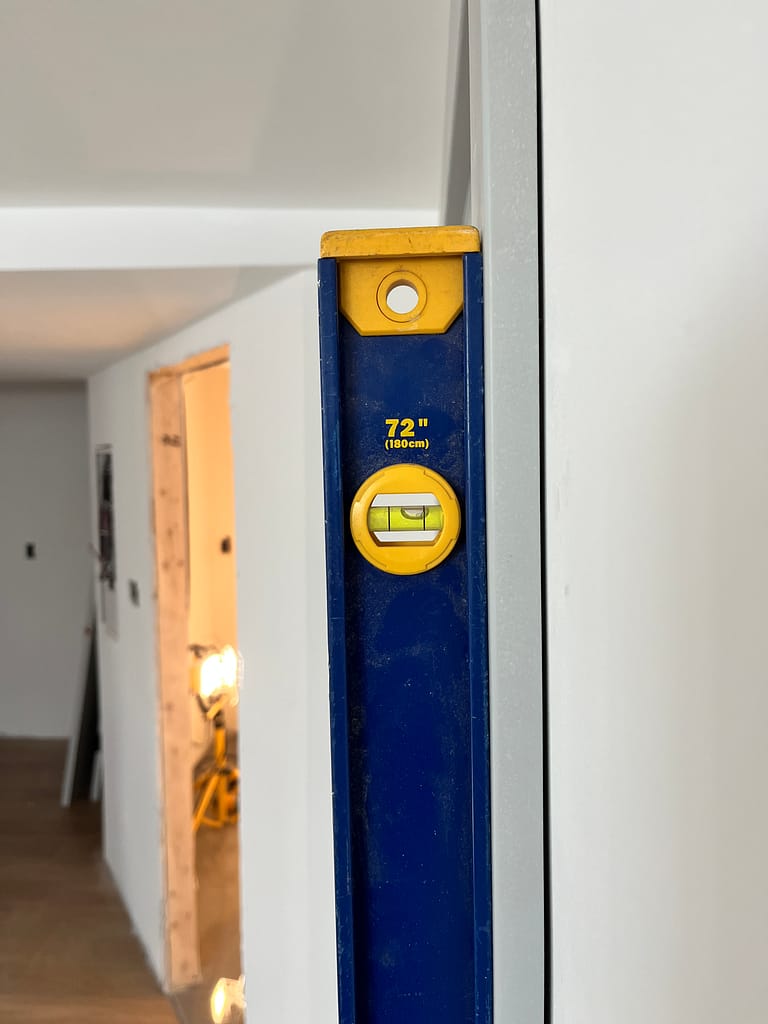
A new slab has to fit the jamb that is already there.
Check the jamb at the top, middle and bottom. Look for:
- Different widths between the hinge and latch sides
- A head jamb that is not level
- A hinge jamb that is not plumb
- Paint buildup
- Loose or twisted jamb sections
- Damaged hinge mortises
- Cracked strike areas
- Uneven door stop position
- Gaps that change from top to bottom
- A floor that slopes across the opening
If the opening becomes narrower toward the bottom, ordering a door based only on the widest point will create a problem.
If the jamb is twisted, the door may sit against the stop at the top but remain open at the bottom.
This is why replacing a slab inside an existing frame is not always a matter of transferring measurements. The door must be fitted to the real shape of the opening.
Homeowners considering this kind of replacement can also read Can You Replace Interior Doors Without Replacing the Frame?.
Do Not Assume a Hollow-Core Door Can Be Cut Without Limit
Hollow-core doors contain a lightweight internal core with solid blocking around the perimeter.
That solid perimeter is limited.
Removing too much from the edge or bottom can cut through the supporting rail and expose the hollow interior. The bottom blocking may then need to be removed, resized and installed in its new position before the door can be properly finished.
Manufacturer trimming allowances vary between products. Masonite’s support information is one example of why the product instructions should be checked before cutting.
The same principle applies to some solid-core and molded doors. A door may feel solid, but that does not mean unlimited material can be removed without affecting its construction, panel proportions or warranty.
Measure first. Confirm the product second. Cut last.
A Simple Interior Door Measurement Sheet
Create one record for each door. Do not rely on memory when several doors are being replaced.
Door location or room:
Existing slab width, wide face:
Existing slab width, narrow face:
Width at top, middle and bottom:
Height at hinge side, centre and latch side:
Door thickness:
Hinge quantity and size:
Hinge locations measured from the top:
Handle height:
Backset:
Swing direction:
Existing floor clearance:
Beveled or square edges:
Jamb and door stop notes:
New door manufacturer and model:
Product link or specification sheet:
A few minutes spent recording this information can prevent several doors from arriving with the wrong thickness, edge preparation or hardware layout.
When Should a Finish Carpenter Measure Before You Order?

A homeowner can collect useful preliminary measurements, especially when sending photos for an estimate.
Professional measuring is worth considering before ordering when:
- Several doors are being replaced
- Hollow-core doors are being upgraded to solid-core
- The new doors are expensive or custom ordered
- The existing doors already rub or fail to latch
- The jambs are old, painted or visibly uneven
- Door thickness is changing
- The new slabs are factory bored or factory mortised
- Openings are non-standard
- Flooring is being replaced
- The existing door is missing
- The door stop is integral to the jamb
- Measurements differ from one side of the door to the other
The cost of checking the openings is usually small compared with purchasing a full set of doors that need unexpected resizing or cannot be used as ordered.
For homeowners comparing the labour involved, our Ontario interior door installation cost guide explains how slab type, solid-core weight, hardware preparation, resizing, custom jambs and non-standard openings can affect installation pricing.
What to Send Wood Job for a Door Replacement Estimate
For an initial review, send:
- A full photo of each door from both sides
- A photo showing the complete jamb and surrounding casing
- Close-up photos of the hinges
- A close-up of the latch and strike plate
- Width measurements across both door faces
- Door height and thickness
- A photo looking down the edge to show any bevel
- Number of doors
- Project city
- Product links for the doors you are considering
- Information about future flooring or trim work
Clear information may be enough to identify obvious compatibility concerns before materials are purchased.
Wood Job Finish Carpentry provides owner-led interior door installation and replacement for homeowners who want the doors, jambs, hinges, hardware and surrounding trim considered as one complete opening.
For a rough starting conversation, you can send your photos and measurements through the estimate page.
Interior Door Measuring Questions
Should I measure the door or the frame for a slab replacement?
Measure the existing door slab first. Record its width across both faces, height, thickness, edge preparation, hinges and hardware locations. The jamb should then be checked to confirm that the existing door is actually a suitable template.
Is a 30-inch interior door exactly 30 inches wide?
Not always. Thirty inches may be the nominal product size. A prefit or beveled door may have a smaller actual measurement, and the two faces may measure differently. Always confirm the finished dimensions before ordering.
How can I tell whether an interior door is beveled?
Measure across both faces and compare the results. You can also look down the door edge from above or place a small square against it. A beveled edge will not form a perfect 90-degree angle with both faces.
Can a square-edge solid-core door replace a beveled hollow-core door?
Possibly, but it may need resizing or beveling to clear the existing jamb during the swing. The answer depends on the actual door width, jamb clearance, hinge position and door stop. It is better to confirm the new slab’s edge preparation before purchasing it.
Can I replace a 1 3/8-inch door with a 1 3/4-inch door?
It may be possible, but it is not normally a direct swap. Hinges, mortises, hardware, strike alignment and the door stop may need to be changed. Some existing jambs are not suitable for the thicker slab without significant modification.
Do the new hinge locations have to match the old ones?
They need to align with the hinge mortises in the existing jamb unless the jamb is also being modified. When buying a factory-mortised door, measure every hinge location carefully instead of assuming the spacing is standard.
Can a hollow-core door be trimmed to fit?
Only within the limits allowed by its construction and manufacturer. Removing too much can expose the hollow interior or weaken the perimeter blocking. Check the product instructions before purchasing a door that will require substantial resizing.
Should I measure the rough opening when replacing only the slab?
The rough opening is normally more important for a pre-hung unit. For a slab replacement, the existing slab and finished jamb are the main references. If the old door is missing or the jamb is badly out of square, a professional site measurement may be safer.
Where does Wood Job provide interior door replacement?
Wood Job Finish Carpentry provides interior door installation and replacement across Oakville, Milton, Burlington, Mississauga, Cambridge, Guelph, Kitchener, Hamilton, Vaughan, Toronto and nearby communities. Projects can include slab doors, pre-hung doors, solid-core upgrades, jamb adjustments, casing and hardware fitting.




