
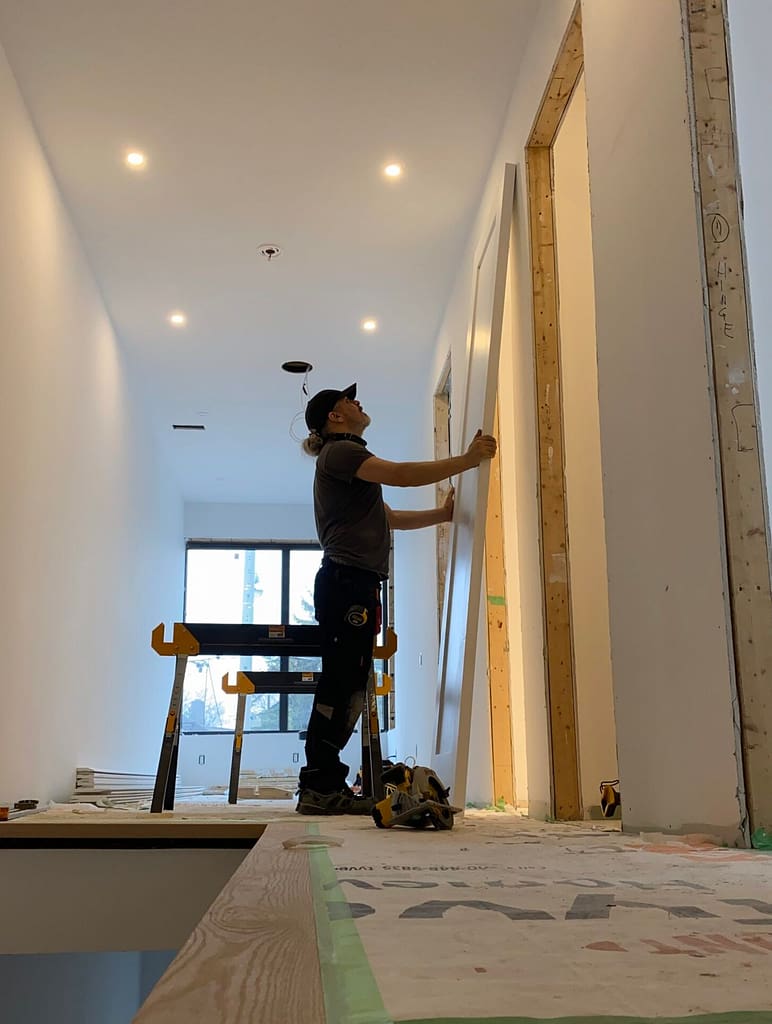
Interior door installation cost in Ontario depends on more than the door itself.
A simple slab door replacement in a good existing jamb is very different from installing a pre-hung door, building a custom jamb, fitting a solid-core door, replacing casing, correcting an uneven opening, or installing French doors.
That is why this guide focuses on labor starting prices, not material-included package prices.
Doors, jambs, hinges, handles, locks, casing, specialty hardware, paint, stain and finish materials can vary widely depending on size, style and quality. Some homeowners prefer to buy the materials themselves. Others prefer Wood Job Finish Carpentry to help source them and add the material cost separately to the estimate.
The labor prices below are meant to help homeowners in Ontario understand the starting budget before requesting a quote for interior door installation and replacement.
Quick Answer: Interior Door Installation Labor Cost in Ontario
For 2026, Wood Job Finish Carpentry’s interior door installation labor starts from:
| Interior Door Installation Type | Labor Starting From |
|---|---|
| Simple slab door replacement | From $150 per door |
| Fitted slab door replacement | From $200 per door |
| Standard pre-hung interior door installation | From $200 per door |
| Pre-hung door installation with casing | From $250 per opening |
| Slab door with custom jamb and casing preparation, hollow-core door | From $300 per opening |
| Slab door with custom jamb and casing preparation, solid-core door | From $350 per opening |
| French doors or double interior doors | From $500 per pair |
These are starting labor prices for standard conditions.
They do not include the door, jamb, casing, hinges, handles, locks, specialty hardware, paint, stain or finish materials.
Normal installation consumables such as nails, screws, adhesive, glue and basic fastening materials are included in the labor price.
★★★★★
77 Google Reviews.
Earned One Job at a Time.
Real projects. Real homes. Real customers.
Wood Job Finish Carpentry is an owner-led finish carpentry business serving Oakville, Milton, Mississauga, Burlington, Cambridge, Guelph, Kitchener, Hamilton, Vaughan, Toronto and surrounding areas.
Many clients call us for interior door installation, solid-core door replacement, custom jambs, casing, trim, French doors, pocket doors, basement doors and full door-and-trim packages.
A good door should not scrape the floor, swing open by itself, refuse to latch or look unfinished around the casing.
A properly installed interior door should feel like it belongs to the home.
2026 Interior Door Installation Labor Starting Prices
Simple Slab Door Replacement — From $150 Per Door
This is the most straightforward type of interior door replacement.
It usually means the existing jamb stays in place, the opening is in good condition, and the new slab door can be prepared and installed without major correction.
This labor price usually includes:
- removing the old door
- preparing the new slab door
- hinge preparation
- handle or lockset boring
- hardware installation
- basic fitting and alignment
This price assumes the existing jamb is straight, solid and usable.
If the new slab door needs resizing, trimming, planing, hinge relocation or latch correction, the job moves into a fitted slab door replacement.
For homeowners comparing options, this is also where the difference between a slab door and a pre-hung door matters. You can read more in Slab Door vs Pre-Hung Door: Which One Do You Need for Interior Door Replacement?
Fitted Slab Door Replacement — From $200 Per Door
A fitted slab door replacement is needed when the door cannot simply be swapped into the old opening.
This may happen when:
- the new slab door is slightly too wide or too tall
- the bottom needs trimming for floor clearance
- hinge locations do not match
- the latch does not meet the strike plate
- the old jamb is not perfectly square
- the old door was cut or installed poorly
- the opening needs more careful adjustment
This is still a slab door replacement, but it requires more finish carpentry work.
The goal is not just to hang the door.
The goal is to make the door swing properly, sit with a clean reveal and latch without force.
If your current door rubs, sticks, swings open or does not latch properly, the issue may not be the door slab alone. For a deeper explanation, see Why Your Interior Door Rubs, Sticks, Swings Open or Won’t Latch.
Standard Pre-Hung Interior Door Installation — From $200 Per Door
A pre-hung door already comes with the door slab, jamb and hinges assembled.
This can be a good option when the existing jamb is damaged, twisted, heavily painted, loose or not worth saving.
The starting labor price applies when the rough opening is ready and suitable for a standard pre-hung door.
This price usually assumes:
- the opening is prepared
- no major framing correction is needed
- the pre-hung unit fits the opening properly
- the jamb can be set, shimmed and fastened cleanly
- no major casing work is included
A pre-hung door is not automatically easier.
It still needs to be installed into a real opening, inside a real home, where walls and floors are not always perfect.
For the full service overview, see Interior Door Installation and Replacement.
Pre-Hung Door Installation With Casing — From $250 Per Opening
This is often the more complete version of a standard pre-hung interior door installation.
It usually includes:
- installing the pre-hung door unit
- setting and aligning the jamb
- installing casing on both sides
- installing the handle or lockset
- checking the swing, reveal and latch
- leaving the opening paint-ready
This is a common option when the old jamb and casing are being replaced together.
It is also common during basement finishing, renovations, full-home door replacement, or when the homeowner wants the door and trim to feel clean and complete.
Door casing is not just decoration. It frames the opening, hides the joint between jamb and wall, and helps the door look finished. If the project includes broader trim work, you may also want to review our finish trim carpentry service.
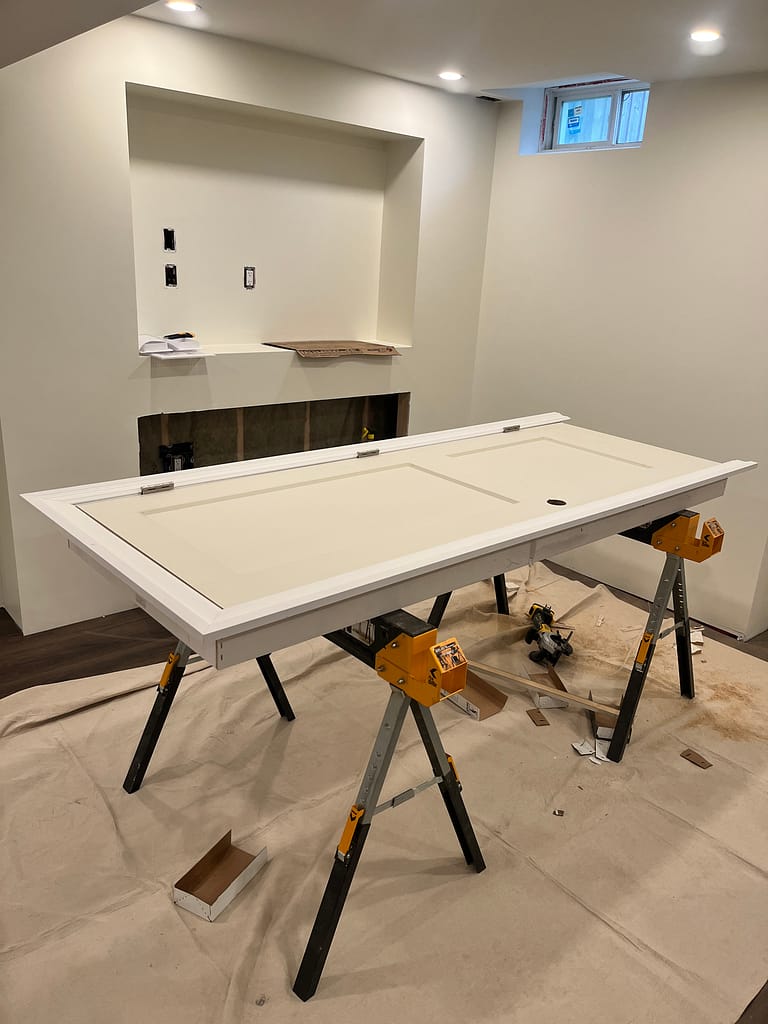
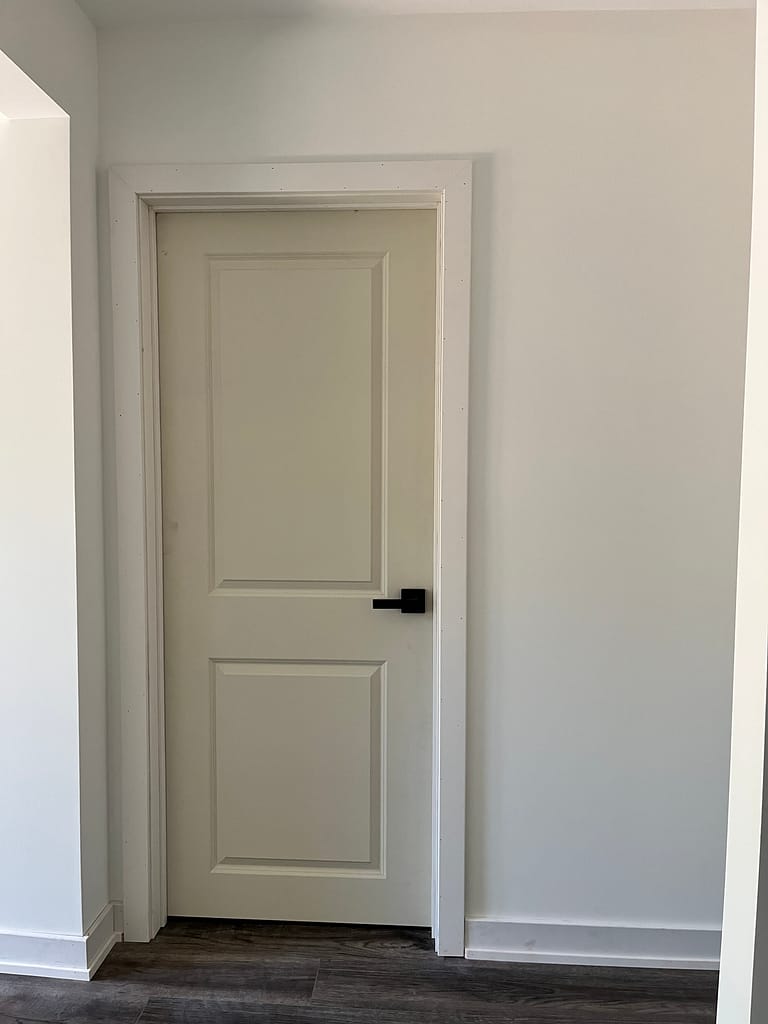
Slab Door With Custom Jamb and Casing Preparation — Hollow-Core Door — From $300 Per Opening
This option applies when the door, jamb and casing all need to be prepared and installed by the carpenter.
It is more involved than installing a ready-made pre-hung door because the jamb, casing and door fitting are built around the actual opening.
For a standard hollow-core interior door, labor starts from $300 per opening.
This usually includes:
- preparing the slab door
- preparing and installing the jamb
- hinge preparation
- latch and hardware preparation
- installing casing
- checking the reveal, swing and latch alignment
This can be a good approach when the opening needs more control than a standard pre-hung package allows.
Slab Door With Custom Jamb and Casing Preparation — Solid-Core Door — From $350 Per Opening
Solid-core doors are heavier than hollow-core doors.
They often feel better, sound quieter and make a home feel more substantial. But they also require more careful installation.
A solid-core door puts more demand on:
- the hinge side
- the jamb
- the screws
- the reveal
- the latch alignment
- the structure of the opening
For a standard solid-core slab door with custom jamb and casing preparation, labor starts from $350 per opening.
A heavier door can expose problems that were easier to ignore with a light builder-grade hollow-core door. That is why solid-core door installation should be handled carefully.
A good example of solid interior doors and casing work can be seen in this Toronto interior solid door and casing installation project.
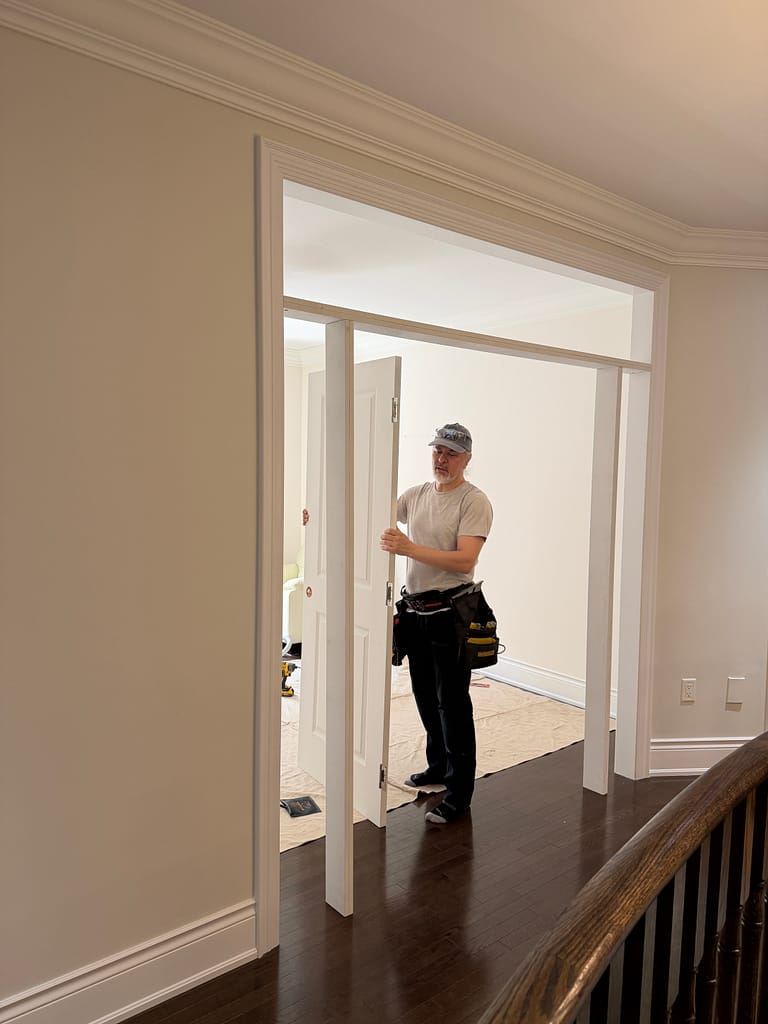
French Doors or Double Interior Doors — From $500 Per Pair
French doors and double interior doors require more alignment than a single door.
One door has to work with the opening.
Two doors have to work with the opening and with each other.
Labor for French doors or double interior doors starts from $500 per pair, depending on the opening and scope.
This usually includes:
- preparing the pair of doors
- installing or preparing the jamb
- setting the reveal between both doors
- installing casing
- installing hinges and hardware
- checking latch, ball catch, astragal or privacy hardware details where applicable
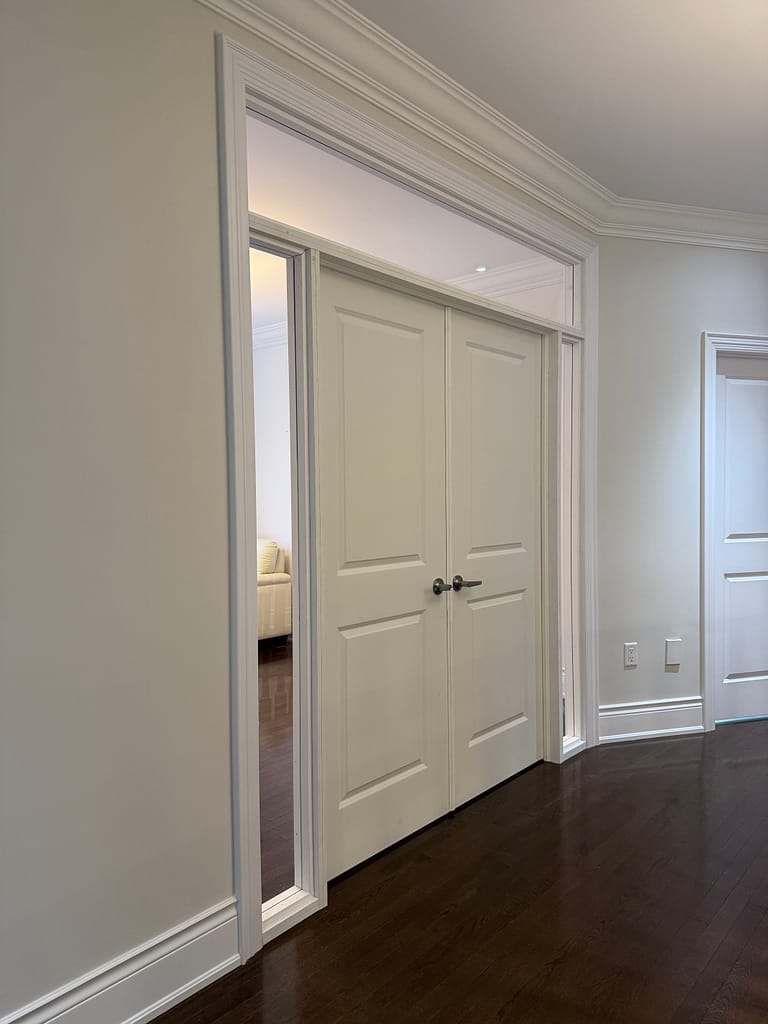
French doors are common for home offices, dining rooms, dens, finished basements and rooms where the homeowner wants privacy without completely closing off the space.
For a real example, see this French doors and transom installation in Oakville project.
What Is Not Included in These Labor Prices?
These are labor starting prices.
They do not include:
- door slabs
- pre-hung door units
- jamb material
- casing material
- hinges
- handles
- locks
- privacy hardware
- specialty hardware
- barn door tracks
- pocket door frames
- glass doors
- paint
- stain
- caulking for final painting
- major drywall repair
- major framing repair
- disposal fees where required
If you want Wood Job Finish Carpentry to supply materials, that can be added separately to the estimate.
Material cost depends on the door size, style, core type, supplier, hardware choice and finish expectations.
What Can Change the Final Labor Price?
The starting prices above assume standard conditions.
The final labor price can change if the door or opening needs extra work.
Common factors include:
- the door needs to be resized, trimmed or planed
- the existing jamb is twisted, damaged or out of square
- hinge locations do not match
- the latch does not meet the strike plate properly
- the strike plate needs correction
- the wall is uneven around the casing
- the floor is not level
- the door is solid-core, oversized, glass or unusually heavy
- the opening is non-standard
- casing needs to be replaced or custom-fitted
- old installation work needs to be corrected first
- multiple doors in the same home have different conditions
- the project is far from the main service route
- parking, access or scheduling creates extra time
A door can look simple after it is installed.
But the opening decides the work.
If the jamb is not straight, the floor has changed, the latch does not line up or the casing hides rough conditions, the installation becomes more than a quick swap.
Why We Give Labor Prices Instead of Material-Included Prices
Material-included prices can be misleading for interior door installation.
One homeowner may choose a basic hollow-core slab.
Another may choose a solid-core shaker door.
Another may want glass French doors, black hinges, privacy hardware, custom casing and upgraded jamb material.
Those are not the same project.
That is why Wood Job Finish Carpentry separates labor from materials.
The labor price reflects the carpentry work.
The material price depends on what you choose.
This makes the estimate clearer and fairer.
Slab Door or Pre-Hung Door: Which One Costs Less?
A slab door is usually less expensive when the existing jamb is in good condition.
But a slab door is not always the cheapest answer.
If the old jamb is twisted, damaged, loose, badly painted or out of square, fitting a new slab door into the old frame can take more time than expected.
A pre-hung door may cost more in labor when casing and jamb work are included, but it can make sense when the old frame is not worth saving.
The better question is not only:
“How much is the door?”
The better question is:
“Is the existing opening good enough to keep?”
If the jamb is good, a slab door may be the right choice.
If the jamb is bad, a pre-hung door or custom jamb may give a better final result.
For a deeper explanation, read Slab Door vs Pre-Hung Door: Which One Do You Need for Interior Door Replacement?.
Solid-Core Door Replacement: Why It Can Cost More
Many Ontario homeowners want to replace builder-grade hollow-core doors with solid-core doors.
It is a good upgrade.
Solid-core doors can make bedrooms, bathrooms, offices and basements feel quieter, more private and more finished.
But solid-core doors are heavier.
That means the installation needs more care.
The hinge side needs better support. The screws need to hold properly. The door needs to be aligned cleanly. The latch and strike plate need to meet without force.
A solid-core door installed into a weak or twisted jamb can create problems later.
That is why the labor starting price for solid-core door installation is higher when custom jamb and casing preparation are needed.
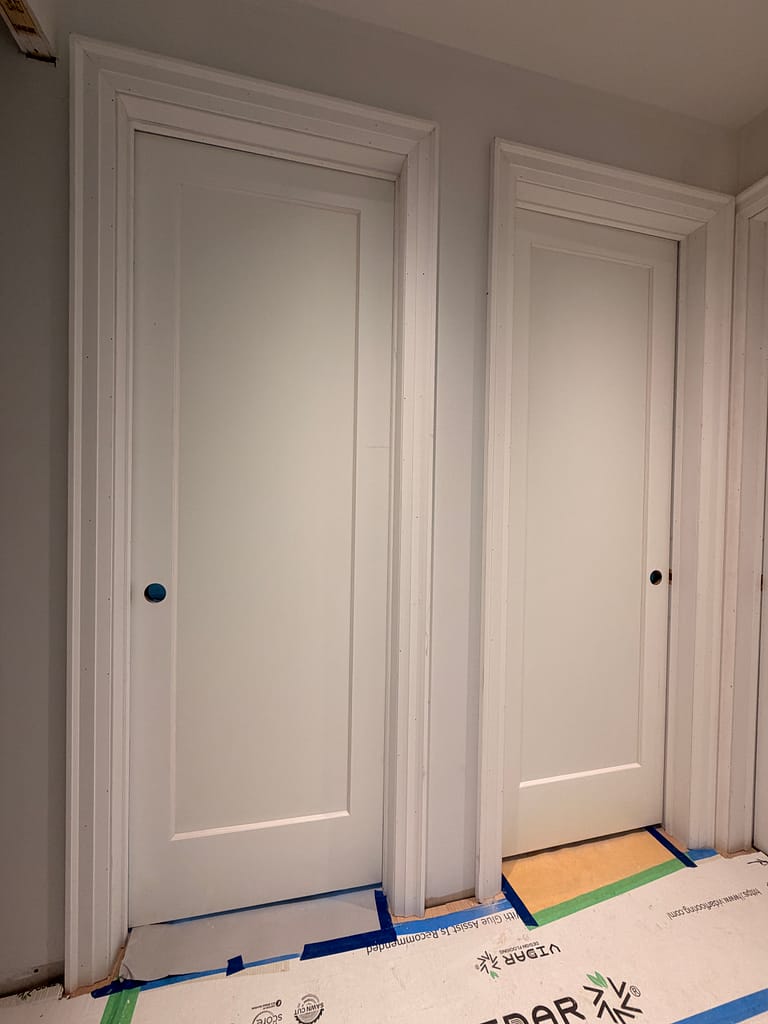
For a real project example, see our Solid Door and Trim Replacement in Oakville.

Why Casing Matters Around Interior Doors
Casing is the trim around the door opening.
It hides the joint between the jamb and wall, frames the door visually and helps the opening feel finished.
Even a well-installed door can look unfinished if the casing is poorly fitted.
Good casing should:
- meet cleanly at the corners
- sit properly against the wall
- create a balanced reveal
- connect naturally with the baseboards
- match the style of the home
- make the door feel built into the room
When replacing interior doors, casing is often part of the real cost.
If the old casing is damaged, too narrow, heavily painted, or does not suit the new doors, replacing it can make the final result much better.
For related trim work, see Finish Trim Carpentry.
Why Some Interior Doors Rub, Stick or Won’t Latch
If your door rubs, sticks, swings open by itself or will not latch, the problem may not be the door slab.
Common causes include:
- loose hinges
- stripped hinge screws
- a shifted jamb
- seasonal movement
- an uneven floor
- paint buildup
- latch misalignment
- strike plate position
- an out-of-square opening
- a door that was cut poorly before
Before replacing the door, it is worth understanding the problem.
Sometimes the door needs adjustment.
Sometimes the slab needs replacing.
Sometimes the jamb is the real issue.
Sometimes the previous installation needs to be corrected before the new door can work properly.
For more detail, read Why Your Interior Door Rubs, Sticks, Swings Open or Won’t Latch.
Interior Door Installation for Older Homes
Older homes often need more patience.
The opening may have moved over time. Floors may slope. Walls may not be flat. Old casing may hide rough drywall or plaster. Hinges may be painted over many times. The existing jamb may not be square anymore.
That does not mean the door cannot be improved.
It means the condition should be checked before ordering, cutting or installing the new door.
In older homes, the cheapest installation price is not always the best value.
A rushed installation can leave you with the same old problem wearing a new door.
This is especially common in older Toronto, Hamilton, Kitchener and Oakville homes, where the door opening often tells more of the story than the door itself.
Interior Door Installation for Newer Builder-Grade Homes
Newer homes can also benefit from door replacement.
Many newer subdivision homes have basic hollow-core doors, simple casing and lightweight hardware.
Replacing those doors with shaker-style or solid-core doors can change the feeling of the home without turning it into a full renovation.
This is common in Oakville, Milton, Burlington, Mississauga, Cambridge, Guelph, Kitchener, Vaughan and Toronto-area homes.
The key is to check whether the existing jambs and hinges can support the upgrade.
If not, the project may need more than a simple slab swap.
Interior Door Installation Cost by Project Location
The basic labor logic is similar across Ontario, but home types can vary by city.
An older Oakville home, a newer Milton subdivision house, a Mississauga condo, a Cambridge basement, a Burlington family home, a Guelph rental property, a Kitchener renovation, a Vaughan home office project and a Toronto older-house renovation can all create different door conditions.
That is why Wood Job Finish Carpentry reviews the actual project before confirming final pricing.
Interior Door Installation in Oakville
Oakville homes often include full-home door replacement, solid-core upgrades, custom trim, French doors, pocket doors, casing and higher-detail finish carpentry.
See Interior Door Installation in Oakville.
Interior Door Installation in Milton
Milton homes often include builder-grade door replacement, shaker door upgrades, basement doors, casing updates and full-home door refreshes.
See Interior Door Installation in Milton.
Interior Door Installation in Cambridge
Cambridge projects often include solid-core doors, slab doors, pre-hung doors, custom jambs, casing, basement doors and door-and-trim packages.
See Interior Door Installation in Cambridge.
Interior Door Installation in Mississauga
Mississauga homes can include condos, townhomes, detached homes, renovated interiors and solid-core door upgrades.
See Interior Door Installation in Mississauga.
Interior Door Installation in Burlington
Burlington projects often include bedroom doors, bathroom doors, closet doors, shaker doors, solid-core replacements, casing and clean trim details.
See Interior Door Installation in Burlington.
Interior Door Installation in Guelph
Guelph projects may include older home openings, rental property updates, solid-core upgrades, basement doors, casing and practical door replacement.
See Interior Door Installation in Guelph.
Interior Door and Trim Work in Kitchener
Kitchener renovation projects often involve completing or correcting doors, trim, casing, baseboards and unfinished finish carpentry.
See Finish Carpenter in Kitchener.
Interior Door and Trim Work in Hamilton
Hamilton projects may include older homes, condos, closet doors, interior door replacement, trim updates and practical finish carpentry.
See Finish Carpenter in Hamilton.
Interior Door and Casing Work in Toronto
Toronto homes often involve older openings, solid doors, casing, phased projects, glass double doors and renovation finishing.
See this Toronto interior solid door and casing installation.
Interior Door and Finish Carpentry in Vaughan
Vaughan homes often include builder-grade updates, home office glass doors, double doors, trim packages, casing and custom openings.
See Finish Carpenter in Vaughan.
Real Project Examples
Oakville Interior Door Replacement and Trim Upgrade
A full door and trim replacement can change the feeling of a home without becoming a full renovation.
In one Oakville project, older builder-grade doors and dated trim were replaced with cleaner one-panel shaker doors, casing, baseboards and window trim.
This kind of project shows why interior door replacement is often connected to the surrounding finish carpentry.
See Interior Door Replacement in Oakville.
Oakville Pocket Door Installation for an Interior Designer
Not every door project is a full house.
Sometimes the job is one door, but it still needs to be done carefully.
In an Oakville interior designer project, a pocket door had to be installed properly with casing and privacy hardware inside a bathroom area.
This is a good example of why pocket doors need more attention than a standard swing door.
See Pocket Door Installation in Oakville for an Interior Designer.
Toronto Solid Interior Door and Casing Installation
A Toronto homeowner needed 7-foot solid interior doors installed with casing, followed later by glass double doors when the materials arrived.
This project is a good example of a focused door-and-casing scope.
It also shows why material timing, phased work and solid-door handling matter.
See Toronto Interior Solid Door and Casing Installation.
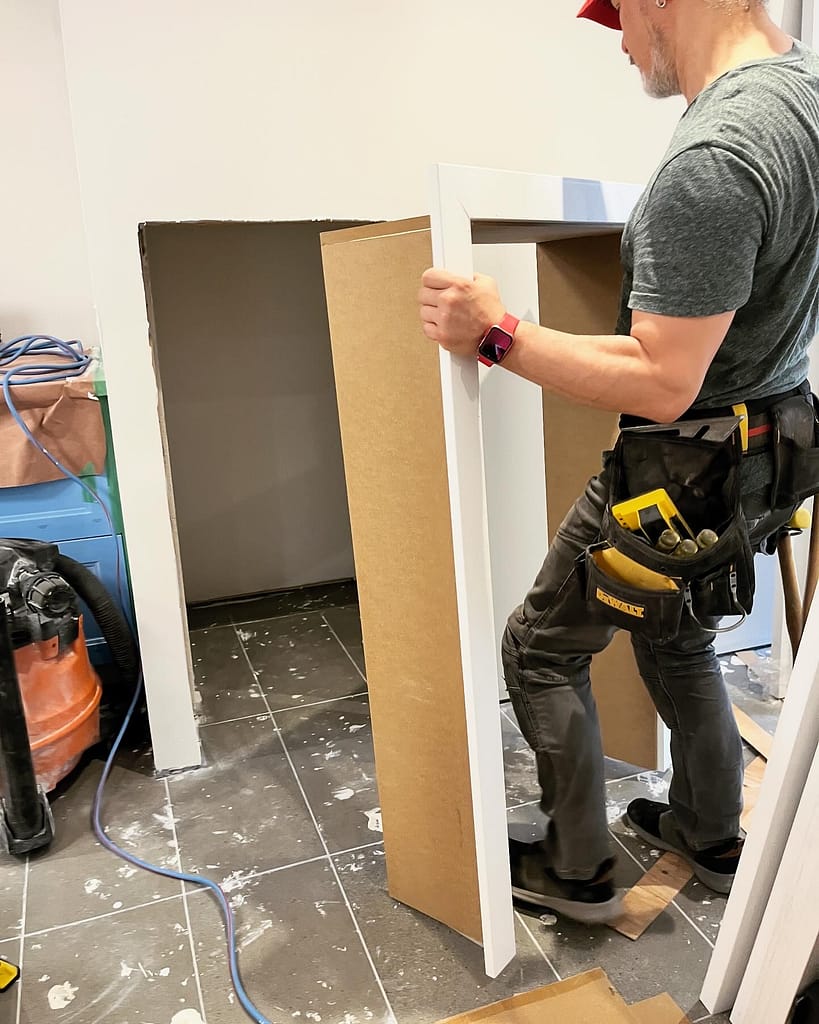
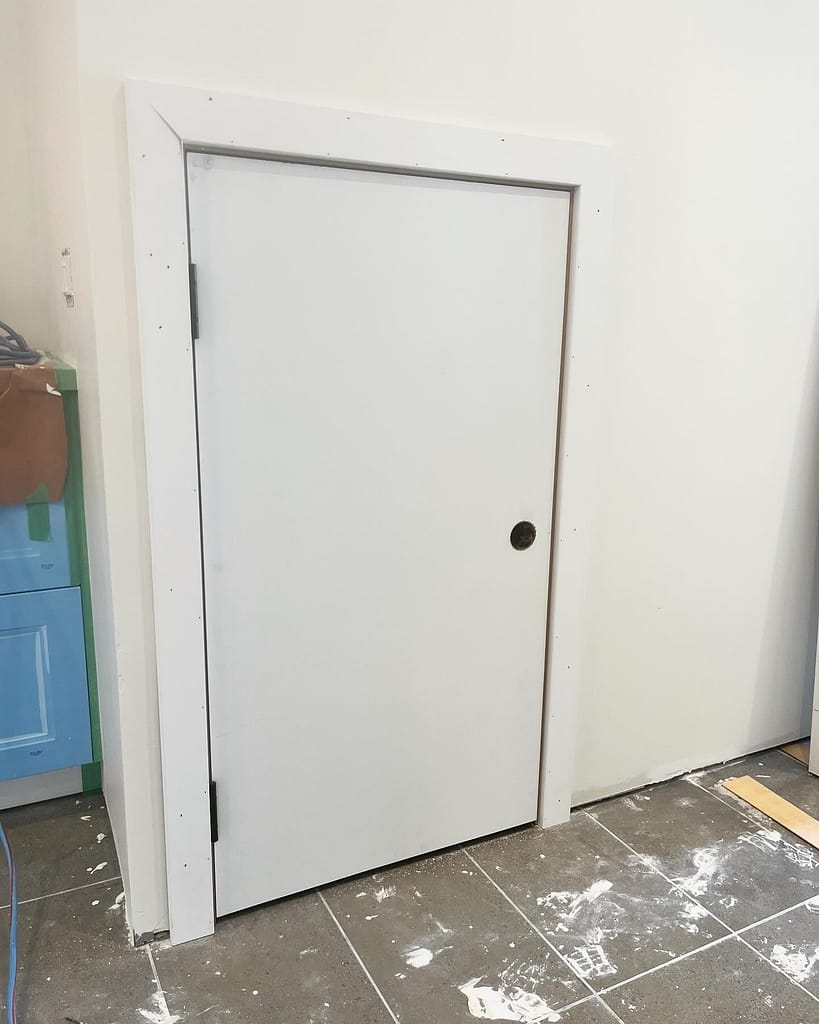
Kitchener Unfinished Door and Trim Correction
Sometimes the cost of door installation becomes higher because previous work has to be corrected first.
In a Kitchener project, Wood Job Finish Carpentry was called to complete and correct unfinished door and trim work after poor installation.
This kind of project shows why doors, casing, jambs and trim should be handled by someone who understands finish carpentry.
See Correcting Unfinished Door and Trim Work in Kitchener.
Oakville French Doors and Transom Project
French doors, double doors and transom details require careful alignment.
They are not just two doors placed side by side.
The reveal, casing, latch, glass panels, privacy needs and surrounding trim all matter.
See French Doors and Transom Installation in Oakville.
What Photos Should You Send for an Estimate?
Clear photos help us understand the project before giving a rough estimate.
For interior door installation, useful photos include:
- each door opening from both sides
- the existing door, if there is one
- the hinge side
- the latch side
- the strike plate
- the casing around the door
- the floor clearance under the door
- the top of the door and jamb
- any damaged, twisted or unfinished areas
- a wide photo of the room or hallway
- a photo of the new doors or materials, if already purchased
Also include:
- how many doors you need installed
- whether they are slab doors or pre-hung doors
- whether they are hollow-core or solid-core
- the door sizes, if known
- whether casing is included
- whether hardware is already purchased
- your city or project location
- whether the home is occupied, empty or under renovation
For many projects, photos are enough to start with a rough labor range.
For more complicated openings, a walkthrough may be better.
When Is an On-Site Visit Needed?
An on-site visit may be needed when:
- the opening is unusual
- multiple doors have different conditions
- the home is older
- the jambs are damaged
- floors are uneven
- the project involves French doors, pocket doors or transoms
- the scope includes casing, baseboards and trim together
- previous work needs to be corrected
- exact material planning is needed
Photos are helpful, but some things are easier to understand in person.
A door opening is three-dimensional.
The reveal, swing, latch, wall condition, floor level and casing all affect the final result.
Should You Buy the Doors Before Getting an Estimate?
You can, but it is safer to check the opening first.
A door that looks standard in the store may not be the best fit for your actual opening.
Before buying doors, consider:
- Is the existing jamb staying?
- Are the hinge locations usable?
- Does the slab need to match old hinge positions?
- Is the door hollow-core or solid-core?
- Is the floor clearance correct?
- Is the opening square?
- Is the wall thickness standard?
- Is casing being replaced?
- Is the handle height important?
- Are all doors in the home the same size?
Buying the wrong doors can create extra labor.
If you are not sure, send photos first.
Why Cheap Door Installation Can Become Expensive
A low starting price is only helpful if the job is truly simple.
If the installer ignores the condition of the jamb, hinge side, latch, casing or floor, the door may look installed but still work badly.
A poor installation can lead to:
- rubbing
- uneven gaps
- loose hinges
- latch problems
- visible casing gaps
- doors that swing open
- doors that need to be slammed
- damaged edges
- awkward floor clearance
- trim that does not meet cleanly
A door is used every day.
If it is wrong, you feel it every day.
That is why Wood Job Finish Carpentry focuses on the opening, not only the door.
Interior Door Installation Service Areas
Wood Job Finish Carpentry provides owner-led interior door installation and replacement and related finish carpentry across:
- Oakville
- Milton
- Burlington
- Mississauga
- Cambridge
- Guelph
- Kitchener
- Hamilton
- Vaughan
- Toronto
- Etobicoke
Request an Interior Door Installation Estimate
If you are planning interior door installation, door replacement, solid-core door upgrades, French doors, pocket doors, casing or custom jamb work, send photos and basic project details.
A useful first message includes:
- your city
- number of doors
- slab or pre-hung, if known
- hollow-core or solid-core, if known
- whether casing is included
- whether hardware is already purchased
- photos of both sides of each opening
- photos of hinges, latch and strike plate
- any problem you are trying to solve
Wood Job Finish Carpentry can review the details and let you know whether a rough estimate is possible from photos or whether an on-site visit would be better.
Interior door installation starts with the door.
But the final result depends on the opening, the jamb, the casing, the hardware and the carpenter who takes responsibility for the details.
Interior Door Installation Cost FAQ
How much does interior door installation labor cost in Ontario?
For 2026, Wood Job Finish Carpentry’s interior door installation labor starts from $150 per door for a simple slab replacement. Fitted slab doors start from $200. Standard pre-hung door installation starts from $200. Pre-hung door installation with casing starts from $250 per opening. Custom jamb and casing preparation starts from $300 for hollow-core doors and $350 for solid-core doors. French doors or double interior doors start from $500 per pair.
Are materials included in these prices?
No. These are labor starting prices. Doors, jambs, casing, hinges, handles, locks, specialty hardware, paint, stain and finish materials are not included. Basic installation consumables such as nails, screws, adhesive and fastening materials are included.
Can I buy the doors myself?
Yes. Many homeowners buy their own doors, hardware and materials. It is still a good idea to check the openings before purchasing, especially if the home has older jambs, non-standard sizes or solid-core upgrades.
Can Wood Job supply the materials?
Yes, in many cases. If you want Wood Job Finish Carpentry to supply materials, the material cost can be added separately to the estimate.
Why does a slab door sometimes cost more than expected?
A slab door costs more when it needs extra fitting. This can include trimming, planing, resizing, hinge mortising, latch boring, strike plate adjustment or correcting small problems in the existing opening.
Is a pre-hung door better than a slab door?
Not always. A slab door can be a good option if the existing jamb is straight and solid. A pre-hung door may be better if the old jamb is damaged, twisted or not worth saving. The right choice depends on the opening.
For more detail, see Slab Door vs Pre-Hung Door: Which One Do You Need for Interior Door Replacement?.
Why does solid-core door installation cost more?
Solid-core doors are heavier than hollow-core doors. They need better hinge support, careful alignment, proper fastening and clean latch adjustment. A heavy door makes weak jambs or poor installation more obvious.
Do I need new casing when replacing interior doors?
Not always. If the existing casing is in good condition and works with the new door and jamb, it may stay. If it is damaged, heavily painted, too narrow or does not sit properly, replacing the casing may give a better finished result.
Can you install French doors or double doors?
Yes. French doors and double interior doors start from $500 per pair for labor, depending on the opening and scope. These projects need careful alignment because both doors must work together.
You can see an example here: French Doors and Transom Installation in Oakville.
Can you fix door work another contractor left unfinished?
In many cases, yes. Send photos of the current condition, including the door, jamb, casing, hinges, latch, strike plate and surrounding trim. Some work can be completed cleanly, while badly installed parts may need to be removed and redone.
A real example is this unfinished door and trim correction project in Kitchener.
Do you serve Oakville, Milton, Cambridge and nearby areas?
Yes. Wood Job Finish Carpentry serves Oakville, Milton, Burlington, Mississauga, Cambridge, Guelph, Kitchener, Hamilton, Vaughan, Toronto and surrounding areas.




