
Many newer homes, subdivisions, condos, and basement renovations are built with hollow-core interior doors.
They are light, affordable, and common. But after living with them for a while, many homeowners start to notice the same problems: the doors feel thin, they rattle when they close, they dent easily, and they do not give much privacy between bedrooms, offices, bathrooms, laundry rooms, or basement spaces.
That is usually when the question comes up:
Can we replace these hollow-core doors with solid-core doors?
In many homes, yes. But the door itself is only one part of the finished opening. Before replacing hollow-core doors with solid-core doors, the existing jambs, hinges, casing, latch locations, floor level, hardware, and wall condition should be checked carefully.
A heavier door can feel better, quieter, and more substantial, but it also puts more demand on the opening.
At Wood Job Finish Carpentry, interior door replacement is handled as finish carpentry, not just product installation. The goal is not only to change the door style. The goal is to make sure each door swings properly, latches cleanly, sits with a balanced reveal, and belongs to the room around it.
What Is a Hollow-Core Interior Door?
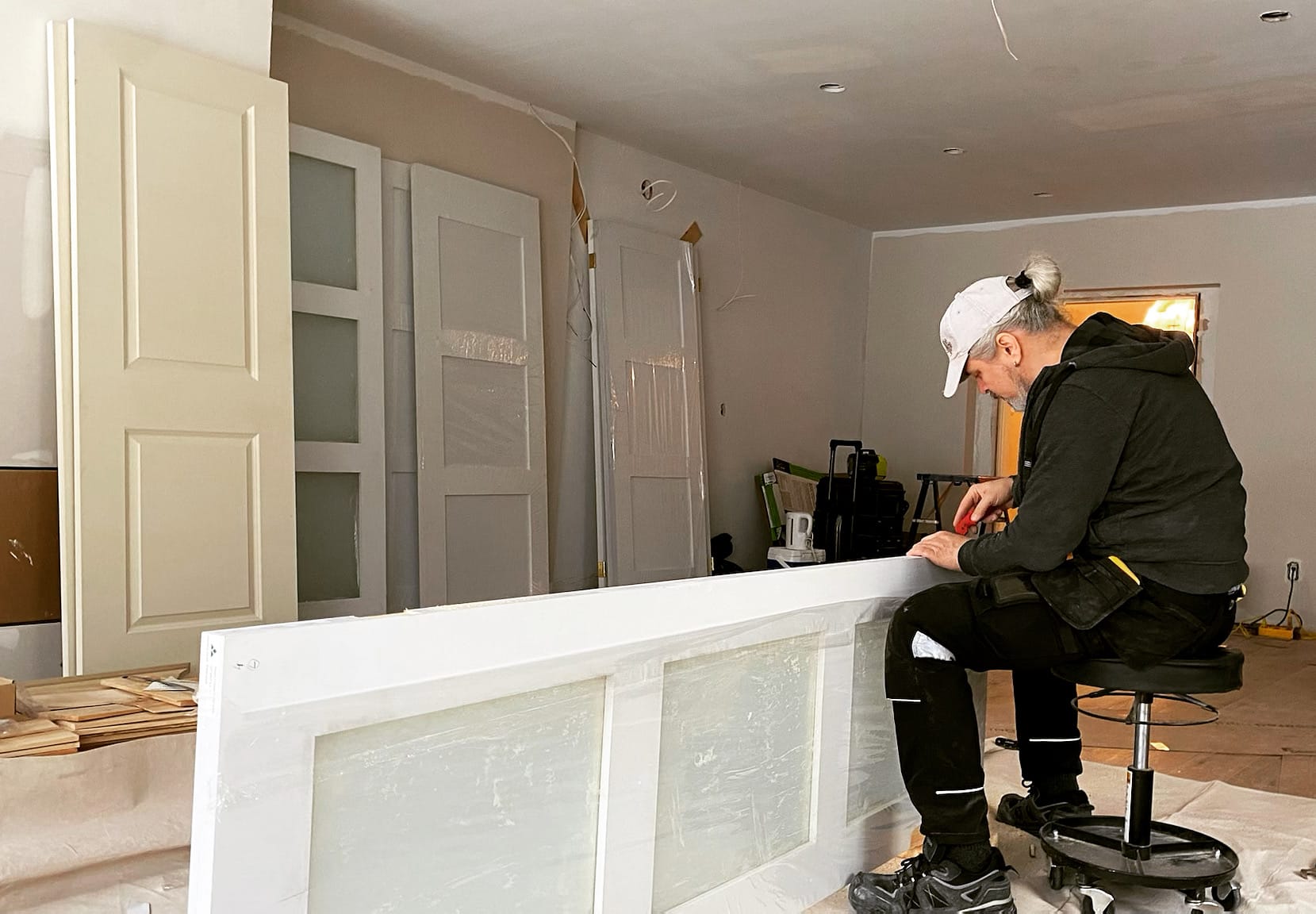
A hollow-core interior door is a lightweight door commonly used in many builder-grade homes.
The outside surface may look finished, but the inside is usually light and mostly empty, often supported by a honeycomb-style core. That makes the door easier to handle and less expensive, but it also affects the way it feels in daily use.
Homeowners often describe hollow-core doors as:
- light
- thin
- noisy when they close
- easy to dent
- less private
- less solid in the hand
- builder-grade in appearance
There is nothing wrong with hollow-core doors when the budget and purpose fit. They are common for closets, secondary rooms, and basic builder packages. But they are not always the best choice when the homeowner wants a quieter bedroom, a more private home office, or a more finished interior feel.
What Is a Solid-Core Interior Door?
A solid-core interior door has a heavier internal core. It is not the same as a fully solid hardwood door, but it feels much more substantial than a hollow-core door.
Solid-core doors are often chosen for:
- bedrooms
- bathrooms
- home offices
- basement rooms
- laundry rooms
- media rooms
- main-floor spaces
- rental suites
- renovated homes
- custom homes
The biggest difference is the feel. A solid-core door has more weight, closes with a more controlled sound, and usually gives the room a more finished impression.
That extra weight is also the reason installation matters.
A solid-core door will not hide a poor opening. If the jamb is weak, twisted, out of plumb, or poorly fastened, the heavier door can make the problem more visible.

Why Homeowners Replace Hollow-Core Doors
Most homeowners do not wake up one morning thinking about door cores.
They notice the daily annoyances first.
A bedroom door feels cheap. A bathroom door rattles. A home office does not feel private. A basement door sounds hollow every time it closes. The old six-panel door style no longer matches the rest of the renovation.
Replacing hollow-core doors with solid-core doors can help with:
- a more substantial feel
- better privacy between rooms
- a quieter closing sound
- a cleaner updated door style
- stronger material feel
- better match with new trim, casing, flooring, or paint
- a more finished look throughout the home
For many homes, interior door replacement is a practical upgrade because doors are used every day. You see them, touch them, open them, close them, and live with them.
But before ordering new doors, the existing openings need to be understood.
Can You Keep the Existing Frames?
Sometimes, yes.
If the existing jambs are straight, solid, properly fastened, and in good condition, it may be possible to replace the door slabs while keeping the existing frames and casing.
This is often called a slab door replacement.
In that case, each new door still has to be fitted to the existing opening. The hinge locations need to be matched or cut properly. The latch and handle location need to line up with the existing strike plate or be adjusted correctly. The edges may need trimming. The door needs to swing without rubbing and close without being forced.
A slab replacement can be a clean option when the existing frame is worth keeping.
But it is not always the right choice.
If the jamb is damaged, twisted, weak, heavily painted, poorly aligned, or not suitable for the new door weight, keeping it may only carry the old problem into the new installation.
When New Jambs May Be Better
Sometimes the better answer is not only a new door, but a new jamb or a more complete door-and-trim installation.
New jambs may make sense when:
- the old jamb is damaged
- the opening is out of plumb
- the existing frame is weak
- the old hinge locations do not work
- the wall thickness does not match standard material
- the casing is outdated or damaged
- the door will be much heavier than the old one
- the opening needs a cleaner finished look
- the old trim was hiding rough drywall or uneven framing
This is common in renovations, basement projects, older homes, and homes where previous work was rushed.
A good finish carpenter should not treat every opening the same way. Some doors can be replaced cleanly as slabs. Some need new jambs. Some need casing changes. Some need custom fitting because the home itself does not give perfect conditions.
The Hinge Side Matters
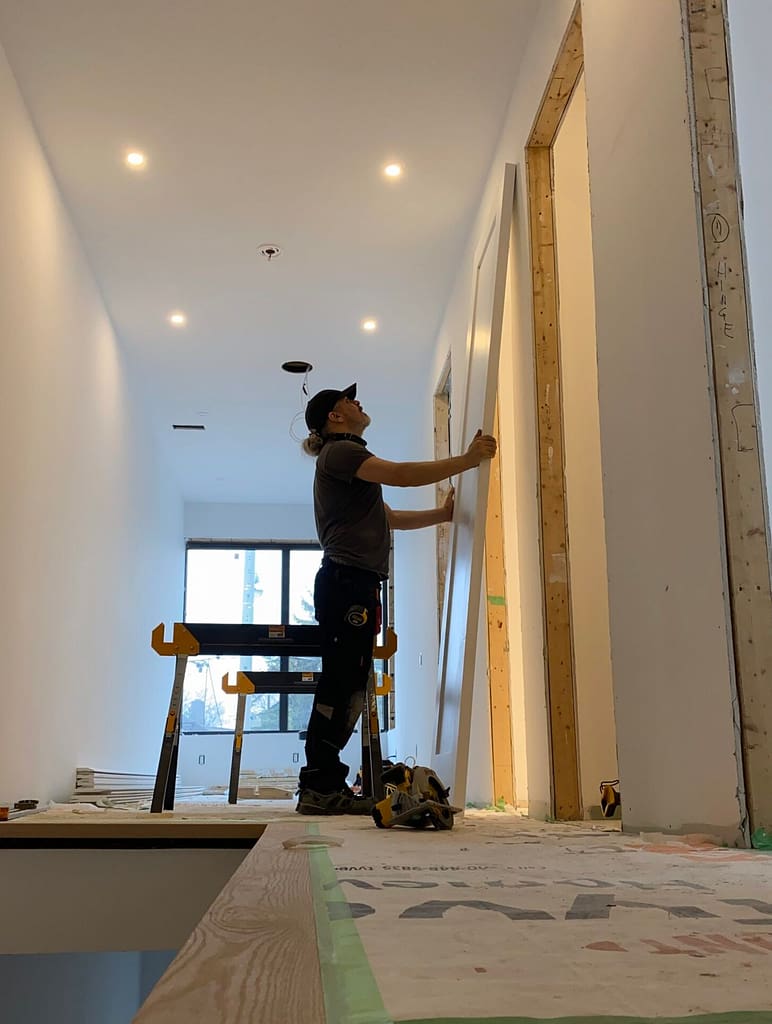
Solid-core doors are heavier than hollow-core doors.
That means the hinge side of the opening needs attention.
On many hollow-core builder doors, two hinges may have been enough because the door was light. With a heavier solid-core door, the hinge layout, screw length, jamb strength, and fastening points become more important.
Depending on the door size, weight, and existing condition, a third hinge may be needed. Longer screws may also be used in the hinge side to help secure the door properly.
The goal is simple: the door should stay where it is installed.
A heavy door that is not supported properly can start to sag, rub, scrape the floor, hit the jamb, or fail to latch. That is why solid-core door replacement should not be treated as a quick swap without checking the opening.
Latch Alignment and Strike Plates
A door can look good and still be frustrating if it does not latch properly.
When replacing interior doors, the latch and strike plate need careful attention. The handle height, bore location, latch edge, strike plate position, door reveal, and jamb alignment all affect how the door closes.
This matters even more when replacing only the slab.
If the new door is being fitted into an existing frame, the new latch location has to work with the old strike area, or the strike plate needs to be adjusted cleanly. If this is rushed, the door may need to be lifted, pushed, pulled, or slammed to close.
A good door should not need a trick.
It should close naturally.
What About the Casing and Trim?
Door replacement often connects with casing and trim.
If the existing casing is clean, solid, and still matches the home, it may be possible to keep it. But if the trim is narrow, damaged, heavily painted, out of style, or not sitting flat against the wall, replacing the casing may give a better finished result.
This is especially true when the homeowner is already updating the door style.
A new solid-core shaker door beside old narrow casing can sometimes feel unfinished. The door improves, but the opening still looks dated.
In other homes, the existing casing is worth keeping and the goal is a quiet door swap with minimal disturbance.
The right answer depends on the condition of the opening and the homeowner’s goal.
That is why interior door replacement should be looked at as a complete finished opening: door, jamb, casing, hinges, latch, hardware, and baseboard transitions.
Slab Door or Prehung Door?
A slab door is only the door itself.
A prehung door comes already attached to a new jamb.
Both can be useful, but they solve different problems.
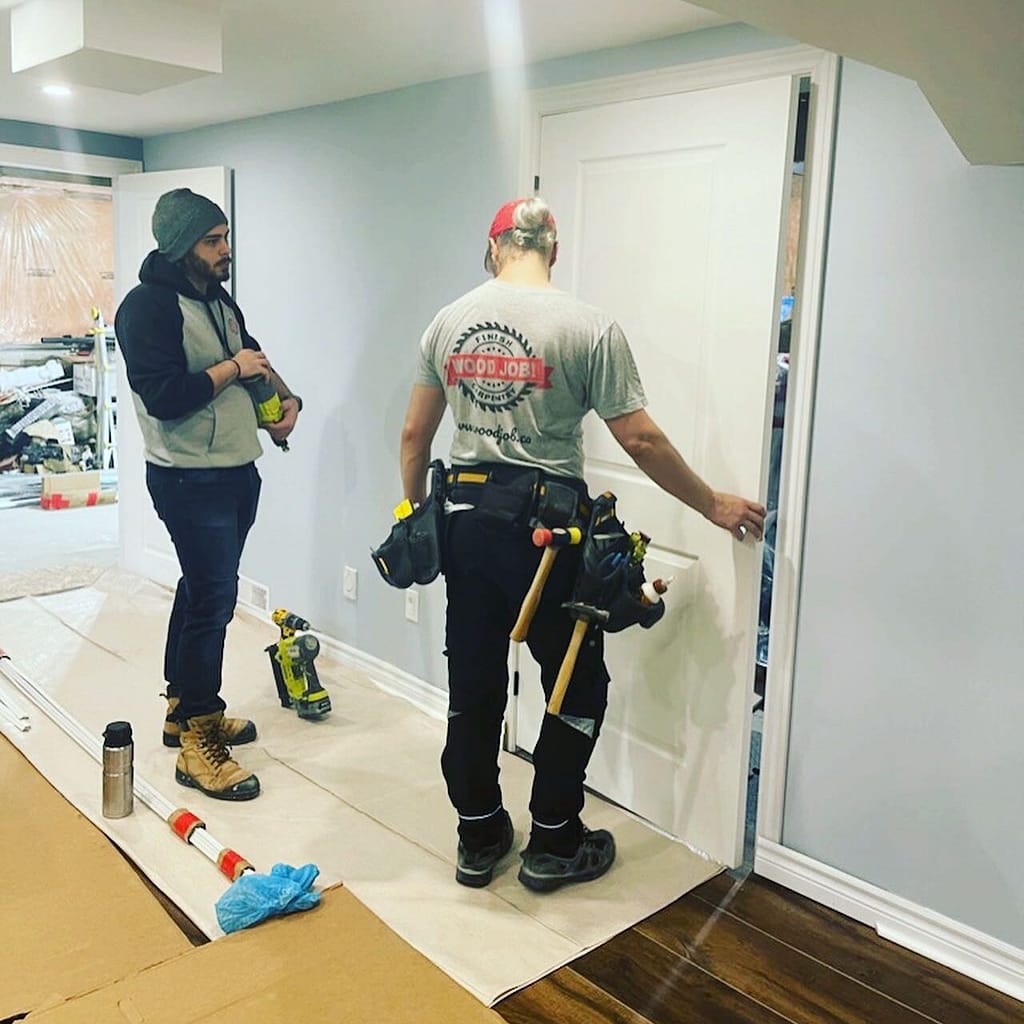
A slab door may be a good option when the existing jamb is solid, straight, and worth keeping. It can reduce disturbance to the surrounding trim, but it requires careful measuring, hinge mortising, trimming, boring, and fitting.
A prehung door may be better when the old frame is damaged, out of plumb, poorly installed, or not worth saving. It gives a new frame, but the opening still has to be installed properly, shimmed correctly, fastened securely, and finished with casing.
A prehung door is not automatically easier in a real home.
If the rough opening, floor, drywall, or wall thickness is not right, even a prehung unit needs careful adjustment.
The better choice depends on the opening.
When Solid-Core Doors Are a Good Upgrade
Solid-core interior doors can be a very good upgrade when the homeowner wants:
- a more substantial door feel
- better bedroom or office privacy
- a cleaner modern style
- less hollow sound between rooms
- a better match with updated trim or flooring
- a more finished look throughout the home
- a door that feels less builder-grade
They often make sense in bedrooms, bathrooms, offices, basements, hallways, and main living areas where the doors are used often and easy to notice.
Solid-core doors are especially worth considering when the home is already being renovated and the trim, casing, flooring, paint, or hardware is also being updated.
That is the right time to think about how the doors fit into the larger finish carpentry package.
When Hollow-Core Doors May Still Be Fine
Solid-core doors are not always necessary.
For some closets, storage rooms, secondary spaces, or budget-focused projects, hollow-core doors may still make sense. They are lighter, easier to handle, and usually less expensive.
The question is not whether solid-core is always better.
The better question is:
Where will the upgrade actually matter?
A homeowner may choose solid-core doors for bedrooms, bathrooms, and offices, while keeping hollow-core doors in closets or storage rooms. That can be a practical way to improve the most important spaces without replacing every door in the home.
A good door plan should match the way the house is actually used.
Real Oakville Example: Replacing Older Interior Doors
A good example is Wood Job’s Oakville project for Jim.
Jim wanted to replace older six-panel interior doors with cleaner raised two-panel doors. The goal was to update the feel of the home without turning the project into a larger renovation.
Because the new doors were being installed into existing frames, preparation mattered. Each door had to be measured, marked, prepared, and fitted so the hinge and hardware locations worked properly.
After the door replacement was completed, Jim left a five-star review mentioning clean, organized work and helpful guidance. Two months later, he invited Wood Job back to install crown moulding on the second floor.
That kind of repeat trust is exactly why door replacement should be handled carefully the first time.
Vaughan Example: Updating Older Six-Panel Doors
Another useful example is the Vaughan interior door replacement project for Joseph.
His home had older six-panel interior doors that were replaced with modern one-panel shaker style doors. The change made the interior feel cleaner and more current without changing the layout of the home.
Joseph also mentioned in his review that Jack helped guide the material decisions during the process.
That matters because door replacement is not only installation. The homeowner also needs to understand material choices, door style, weight, hardware, and how the new doors will work with the existing openings.
What Affects the Cost?
The cost of replacing hollow-core doors with solid-core doors depends on more than the number of doors.
Important factors include:
- number of doors
- door size
- hollow-core or solid-core material
- slab door or prehung door
- existing jamb condition
- whether casing is being replaced
- hardware installation
- hinge layout
- latch and strike plate alignment
- wall and floor conditions
- painting or pre-painted material
- whether the home is occupied or under renovation
- whether the project is one door or a full-home package
A simple slab replacement in a clean opening is very different from a full door, jamb, casing, hardware, and trim replacement.
For a more detailed breakdown, see our guide on interior door installation cost in Ontario.
What Should You Send for an Estimate?
If you are thinking about replacing hollow-core doors with solid-core doors, clear photos are the best starting point.
Useful information includes:
- how many doors you want to replace
- photos of both sides of each door
- close-up photos of the hinges
- close-up photos of the latch and strike plate
- photos of the casing around the door
- whether the casing will stay or be replaced
- current door size, if known
- whether the doors are hollow-core or solid-core
- whether new hardware has already been selected
- your project city
- whether the home is occupied, under renovation, or a new build
A short video can also help if the door rubs, swings open, sticks, or does not latch properly.
Photos make it easier to understand whether the existing frame can be reused or whether new jambs, casing, or custom fitting may be needed.
Owner-Led Interior Door Replacement
Wood Job Finish Carpentry is owner-led by Jack Cenk Ozer.
That matters with interior door replacement because small decisions on site affect the finished result. A hinge may need to be adjusted. A latch may need to be aligned. A reveal may need to be balanced. A casing piece may need to be fitted to a wall that is not perfectly flat.
These are not details that should be treated as an afterthought.
Replacing hollow-core doors with solid-core doors can be a smart upgrade, but the success of the project depends on how the openings are read, prepared, fitted, and finished.
If you are planning interior door replacement, Wood Job can help review the condition of the doors, jambs, casing, hardware, and surrounding trim before recommending the better path.
Interior Door Installation by City
Wood Job Finish Carpentry provides owner-led interior door installation and replacement across Oakville, Milton, Cambridge, Mississauga and surrounding areas.
For city-specific information, you can visit:
- Interior Door Installation in Oakville
- Interior Door Installation in Milton
- Interior Door Installation in Cambridge
- Interior Door Installation in Mississauga
Planning to Replace Hollow-Core Doors?
If your current doors feel light, noisy, dated, or unfinished, replacing them with better interior doors may be worth considering.
The first step is not guessing from a product photo.
The first step is checking the real openings.
Send clear photos, approximate measurements, your project city, and a short description of what you want done. Wood Job can review the doors, jambs, casing, hinges, latch locations, and trim conditions to help you understand the right approach.
Hollow-Core and Solid-Core Door Questions
Can hollow-core doors be replaced with solid-core doors?
Yes, in many homes. The existing jamb, hinges, casing, latch location, and frame condition should be checked first because solid-core doors are heavier and make poor alignment more noticeable.
Do I need to replace the frame when installing solid-core doors?
Not always. If the existing jamb is straight, solid, and worth keeping, a slab door replacement may be possible. If the frame is damaged, weak, twisted, or out of plumb, a new jamb or prehung door may be the better option.
Do solid-core doors need three hinges?
Sometimes. It depends on the size and weight of the door, the existing hinge layout, and the condition of the jamb. Because solid-core doors are heavier than hollow-core doors, the hinge side needs to be checked carefully.
Are solid-core doors better for bedrooms and offices?
They can be a good choice for bedrooms, offices, bathrooms, laundry rooms, and basement spaces where privacy, sound, and a more substantial feel matter. They may not be necessary for every closet or storage room.
Can I replace only some doors in my home?
Yes. Some homeowners upgrade bedrooms, bathrooms, offices, and main visible areas first, while leaving closets or secondary spaces for later. The best plan depends on budget, door condition, and how the rooms are used.
Should casing be replaced when replacing interior doors?
Not always. Existing casing can sometimes stay if it is clean, solid, and works with the new doors. If the casing is damaged, narrow, heavily painted, outdated, or does not sit flat, replacing it may give a cleaner finished result.
What photos should I send for a door replacement estimate?
Send photos of both sides of each door, the hinges, latch, strike plate, casing, floor area, and any door that rubs or does not close properly. Include the number of doors, your project city, and whether you want slab doors, prehung doors, hollow-core doors, or solid-core doors.




