
An interior designer reached out with a clear idea.
She wanted a specific interior door look for her client’s home in Vaughan.
The inspiration photo showed a tall, clean door with a long recessed panel, elegant molding, and a quiet designer feel. The door was simple, but not plain. It had proportion, depth, and a custom look that suited the home.
The problem was timing.
The exact door was not easy to source locally, and the options that came close required a long wait. The project could not sit still for weeks waiting for a special-order door.
So the question became practical:
Could we create the look ourselves?
The answer was yes.
Instead of waiting for a factory-made version of the inspiration door, Wood Job Finish Carpentry used plain slab doors and built the custom look on site with applied molding, careful layout, and clean finish carpentry.
This is the kind of project where working with a designer matters. The idea has to be protected, but it also has to be buildable inside the real home.
Wood Job explains this side of the work here: finish carpentry for interior designers.
★★★★★
76 Google Reviews.
Earned One Job at a Time.
Real projects. Real homes. Real customers.
Wood Job Finish Carpentry is trusted by homeowners and designers who care about clean work, careful details, direct communication and finish carpentry that is handled with personal responsibility.
The Inspiration Was Clear
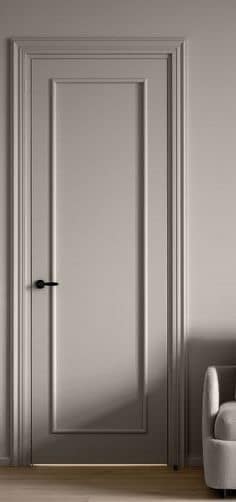
The designer’s reference photo showed the direction.
A tall, narrow panel.
A clean face.
Molding that gave the door depth without making it too busy.
A designer look that felt more refined than a standard builder-grade slab.
That kind of door can change the feeling of a room. It does not shout for attention, but it makes the opening feel more intentional.
The challenge was not understanding the design.
The challenge was finding a practical way to achieve it without delaying the project.
Why a Custom On-Site Solution Made Sense
Sometimes the exact product exists, but the timeline does not work.
Sometimes a door can be ordered, but the wait is too long.
Sometimes the available product does not fit the opening, height, hinge layout, or site condition properly.
In this case, a plain slab door gave us more control.
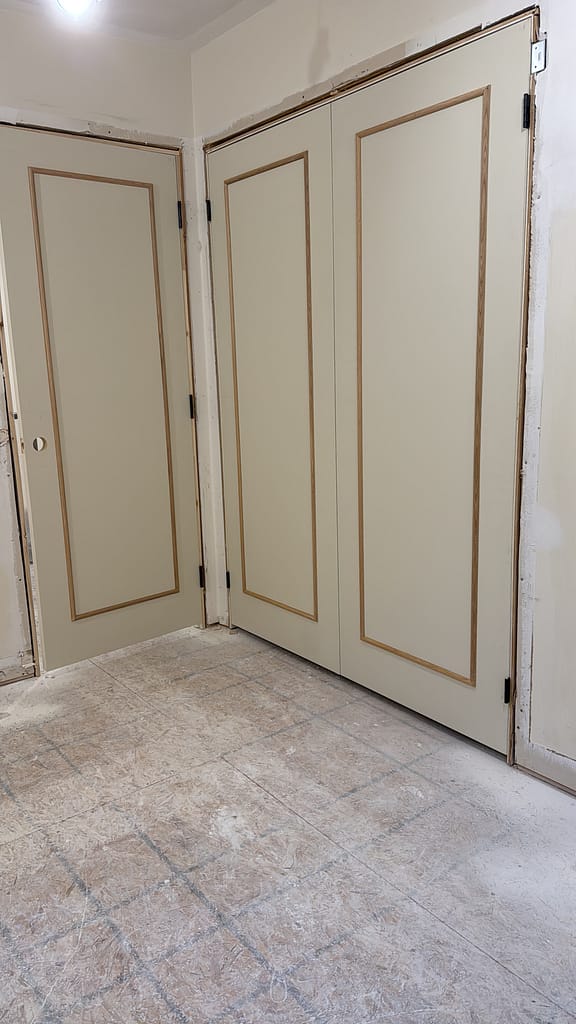
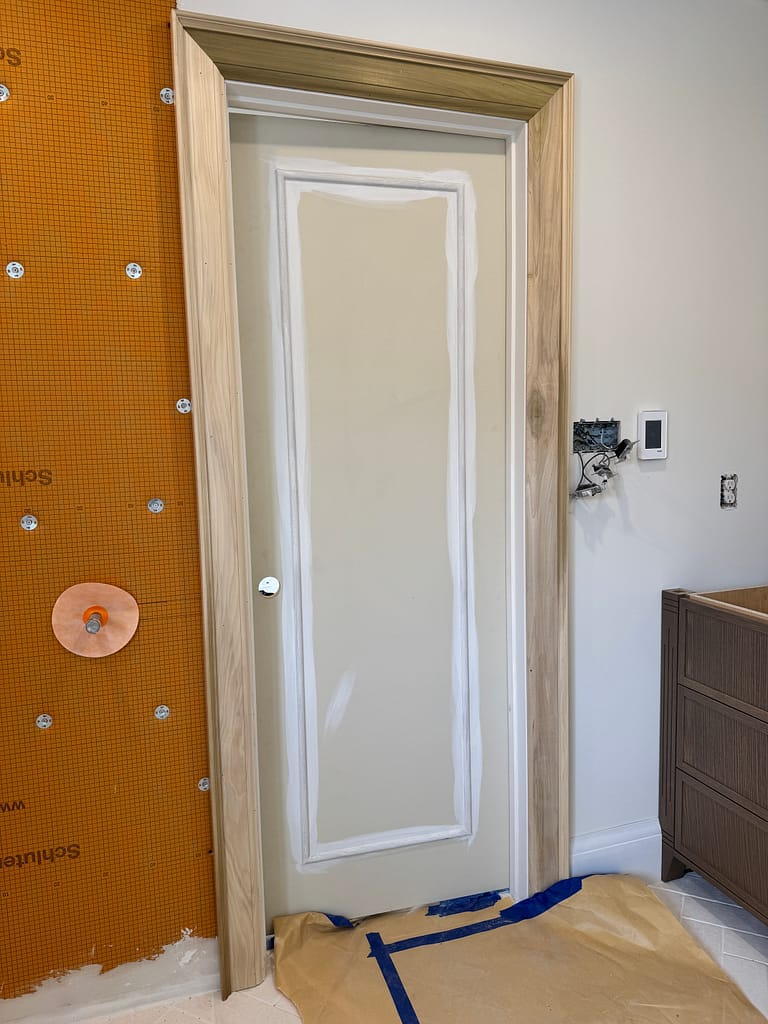
A plain slab became the base. Then the panel layout was marked carefully, and molding was applied to create the long recessed-panel look the designer wanted.
This approach allowed the project to move forward without giving up the design direction.
It also allowed the door detail to be adjusted to the actual site conditions instead of forcing the house to wait for a perfect catalogue item.
For broader door work, Wood Job’s main service page explains how interior doors, casing, hardware, reveals, jambs, and custom fitting are handled: interior door installation and replacement.
From Plain Slab to Designer-Look Door
A plain door is not always the final answer.
Sometimes it is the starting point.
For this project, the slab doors were modified with applied molding to create the look of a more custom door. The molding had to be placed with the right spacing, clean corners, and consistent proportions.
That part matters.
If the panel is too small, the door looks heavy.
If the molding is too close to the edge, the door looks forced.
If the panel is not centered properly, the whole door feels off.
The goal was not to make the doors look “decorated.”
The goal was to make them look designed.
Carrying the Detail Through the Home
The custom door detail was not used in only one spot.
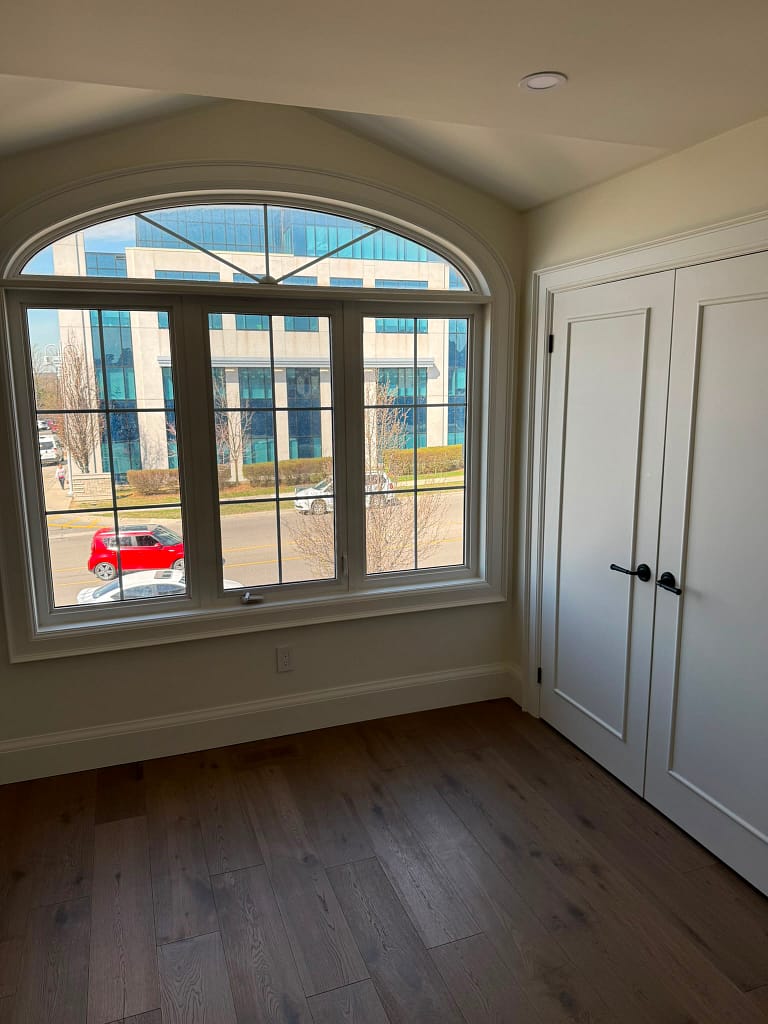
It was carried through different parts of the home, including interior doors, double doors, and a fire-rated door leading to the garage.
That made the work more interesting.
A normal interior slab and a fire-rated door are not the same product. They do not always behave the same way. The surface, weight, hardware requirements, code requirements, and installation conditions can be different.
But visually, the homeowner and designer wanted the door language to stay connected.
So the applied molding detail had to be handled carefully on each door, while still respecting the function of the door itself.
This is where finish carpentry becomes more than copying an inspiration photo.
The detail has to work on the actual door, in the actual opening, with the actual hardware.
The Fire-Rated Garage Door Needed Care
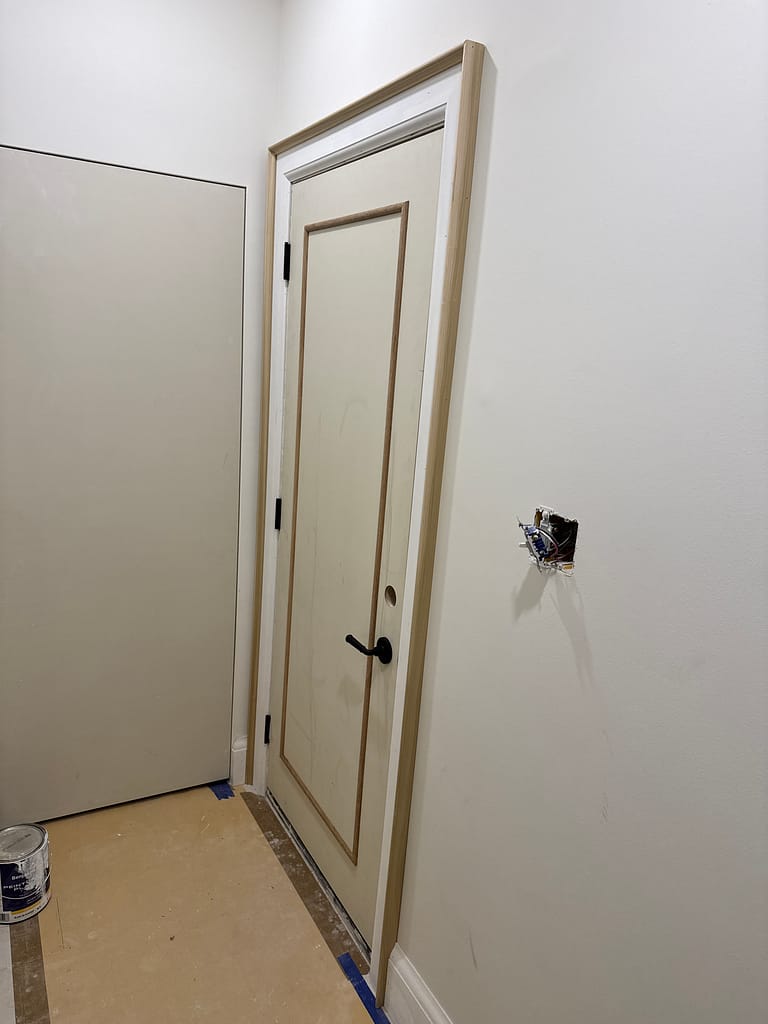
One of the doors opened toward the garage area.
That door had to remain practical and appropriate for its purpose. A fire-rated door is not something to treat casually. The door still needs to function properly, close properly, and accept the correct hardware.
The custom molding detail was applied so the door could visually belong with the rest of the interior doors without ignoring the practical role of the opening.
The result was a cleaner transition between a functional garage access door and the more finished interior spaces around it.
This is a good example of a small design decision that improves how the home feels.
The door still does its job.
But it no longer feels like a leftover utility door.
Hidden Door and Baseboard Continuity
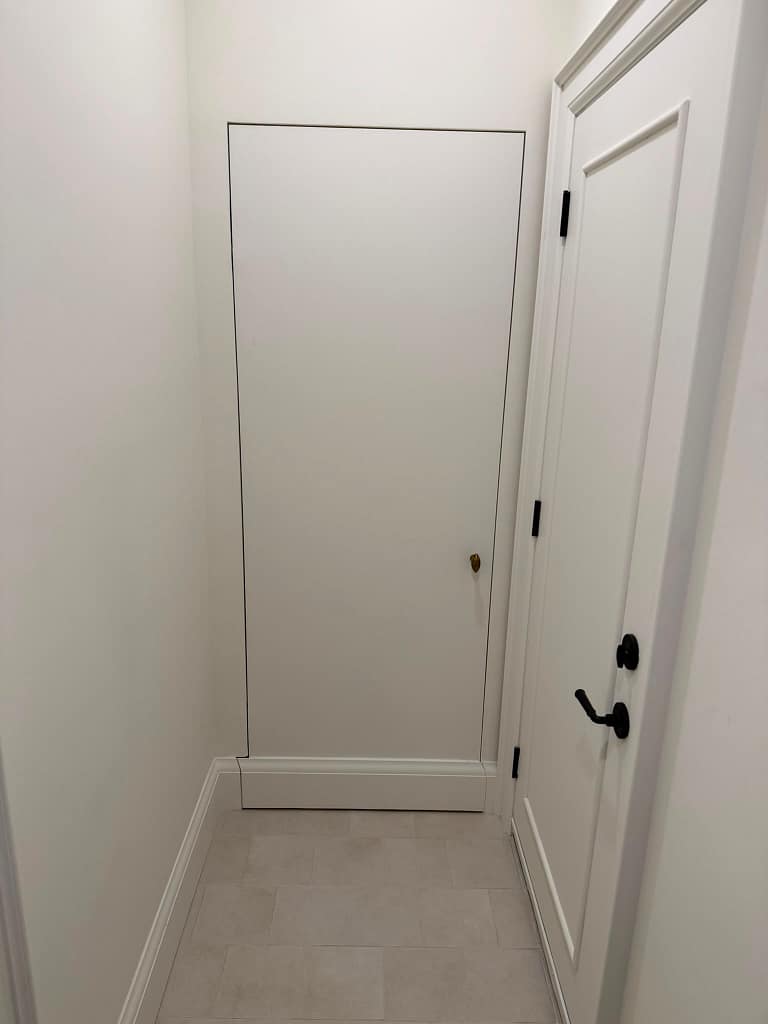
Beside the garage-area door, there was also a hidden door detail.
This kind of detail depends on restraint.
A hidden door should not draw too much attention to itself. The casing, wall line, baseboard, and reveal all have to be thought through so the door disappears as much as possible into the surrounding wall.
In this project, the baseboard continuity mattered.
The baseboard needed to pass through the area cleanly so the wall did not feel interrupted by the hidden door. That kind of detail is easy to underestimate, but it is exactly the kind of thing people notice when it is wrong.
A hidden door is not only about hidden hinges.
It is about how the surrounding trim behaves.
Wood Job’s finish trim work includes casing, baseboards, returns, and small transitions like this. You can see more about that service here: finish trim carpentry.
Working With Designers Means Protecting the Idea
Designers usually bring more than a picture.
They bring proportion, mood, material direction, and a client expectation.
A finish carpenter’s job is not to flatten that idea into the easiest possible version. The job is to understand what matters, explain what is practical, and build the detail cleanly inside the real home.
On this project, the inspiration photo was the starting point.
The real work was figuring out how to create a similar feeling with available materials, site conditions, door sizes, and project timing.
That is why designer collaboration needs clear communication.
The designer needs to know what can be built.
The homeowner needs to know what will be installed.
The carpenter needs to protect the final detail without pretending the jobsite is a showroom.
Door Installation Is Still About the Opening
Even when the visual design is important, the door still has to work.
It has to swing properly.
It has to sit with a clean reveal.
It has to accept the hardware.
It has to close without fighting the jamb.
The casing has to frame the opening cleanly.
The trim has to connect to the rest of the room.
That is why a custom door detail cannot be treated like a decorative add-on only.
The beauty of the door depends on the basics being right.
Wood Job has also completed other Vaughan door projects, including modern shaker door replacement. A related example can be seen here: modern shaker interior door replacement in Vaughan.
The Finished Result
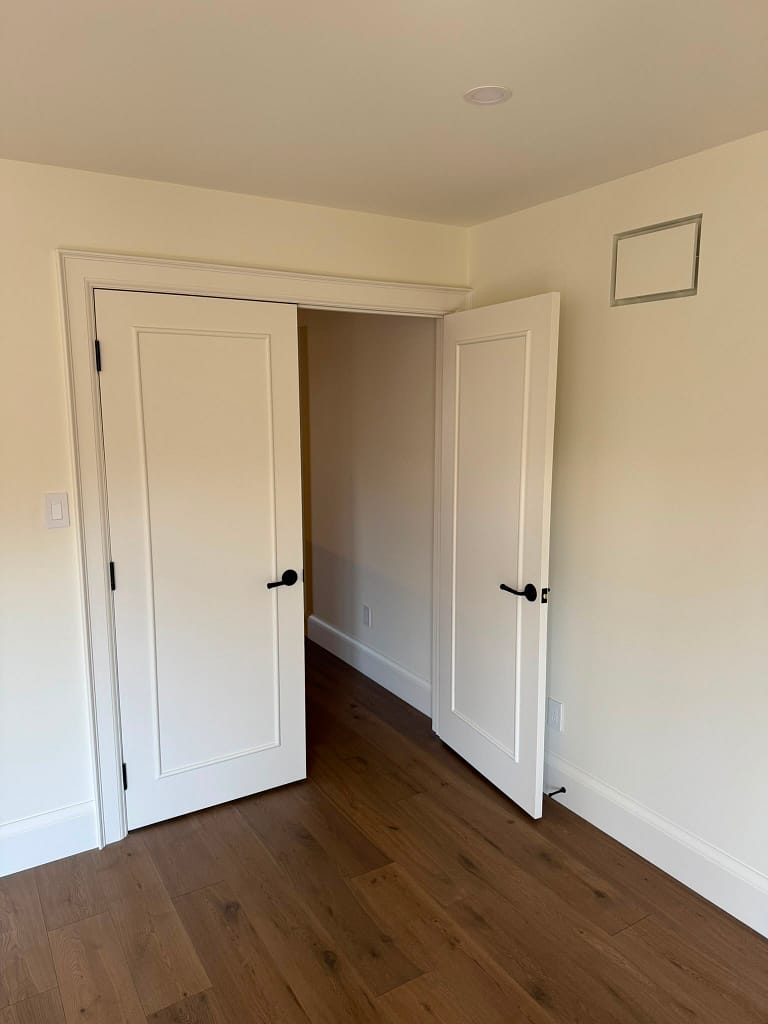
Once the doors were painted and the hardware was installed, the custom molding detail became much quieter.
That is usually the goal.
Before paint, the applied molding stands out because the material is still raw or primed.
After paint, the door becomes one finished piece.
The long panel detail, black hardware, clean casing, baseboards, and surrounding trim worked together to create the designer look the project needed.
The final result did not feel like a workaround.
It felt intentional.
That is the point.
A good custom solution should not look like the project had a problem.
It should look like the home was meant to have that detail.
What Homeowners and Designers Can Learn From This Project
This project is a good reminder that the right finish carpentry solution is not always found in a catalogue.
Sometimes the best answer is a custom-built version of the idea.
Before ordering special doors, it helps to ask:
- Is the exact door available in time?
- Can the look be created from a plain slab?
- Will the detail work on all door sizes?
- Are any doors fire-rated or functionally different?
- Will the casing and baseboards support the design?
- How will hardware affect the final look?
- Will the door still swing, latch, and close properly?
- Does the project need one custom door or a consistent package through the home?
These questions save time.
They also protect the design.
Owner-Led Finish Carpentry in Vaughan
Wood Job Finish Carpentry is owner-led and intentionally small.
That matters on custom door projects because the final result depends on decisions made in the room.
Where should the molding sit?
How should the panel be proportioned?
How does the custom detail work on a double door?
What changes when the door is fire-rated?
How should the casing and baseboard connect to the hidden door?
Those are not generic installation questions.
They are finish carpentry decisions.
Jack Cenk Ozer works directly with these details so the design, installation, and final responsibility stay connected.
For homeowners and designers looking for finish carpentry in the area, Wood Job also has a local page here: finish carpenter in Vaughan.
Planning a Designer-Led Door or Trim Project?
If you have an inspiration photo for interior doors, trim, casing, wall details, or custom openings, send it before ordering materials.
Helpful information includes:
- Inspiration photo
- Project city
- Number of doors
- Door sizes if known
- Existing opening photos
- Whether the doors are slab, pre-hung, or fire-rated
- Hardware style
- Paint or stain direction
- Timeline
- Any designer drawings or notes
Wood Job can review the idea and explain whether the detail can be built with available materials, whether a custom approach makes sense, or whether a different door product would be better.
You can start here:
FAQ
Can a plain slab door be customized to look like a designer door?
Yes, depending on the door, design, material, and opening. In this Vaughan project, plain slab doors were used as the base, and applied molding created the long panel detail the designer wanted.
Is this the same as buying a factory-made custom door?
No. A factory-made custom door is built as that product from the beginning. An on-site custom solution uses an available door slab and adds carefully planned details to create a similar look. It can be a practical option when timing, availability, or site conditions make special-order doors difficult.
Can molding be added to fire-rated doors?
It depends on the door, location, code requirements, and the specific detail. Fire-rated doors should not be casually modified without understanding their purpose. In any project involving a fire-rated opening, function and safety come first.
Do custom door details need to match casing and baseboards?
Yes. A custom door can look unfinished if the casing, baseboard, and surrounding trim do not support the design. The door, trim, hardware, and wall details should feel connected.
Do you work with interior designers?
Yes. Wood Job Finish Carpentry works with interior designers, homeowners, contractors, and renovators on doors, casing, baseboards, wall details, custom openings, and detailed finish carpentry.
Can Wood Job help if I only have an inspiration photo?
Yes. Send the photo, project location, existing opening photos, door count, rough measurements, and timeline. Wood Job can review whether the look can be built, whether a standard product would be better, or whether a custom on-site solution makes sense.
Do you only provide this type of work in Vaughan?
No. Wood Job Finish Carpentry works in Vaughan and also serves nearby cities across Halton, Waterloo Region, and the GTA.
You can view local finish carpentry service pages for Oakville, Milton, Burlington, Mississauga, Cambridge, Guelph, Kitchener, Vaughan, Hamilton, and Toronto.
If your project is outside these cities but nearby, send your location with a few photos and a short description. Wood Job can let you know whether the project is within service range.
Related Services
Finish Carpentry for Interior Designers
Wood Job works with designers on custom doors, accent walls, wainscoting, fireplace features, coffered ceilings, crown moulding, custom trim, and finish carpentry details where proportion, layout, and clean installation matter.
Interior Door Installation
Interior doors, basement doors, closet doors, custom doors, hardware, casing, reveal lines and proper fitting for finished residential spaces.
Finish Trim Carpentry
Baseboards, casing, shoe moulding, window trim, door trim and clean finishing details that help a basement renovation feel complete.
Finish Carpenter in Vaughan
See how Wood Job Finish Carpentry helps Vaughan homeowners with interior doors, trim, baseboards, custom openings, home office doors and renovation finishing.
Finish Carpentry for Homeowners
For homeowners preparing a home before moving in, we can help complete flooring, doors, trim, baseboards and final finish details before furniture arrives.




