
Basement finish carpentry is not only about installing doors and baseboards.
Sometimes the first thing you see when you come down the stairs matters just as much as the rooms behind the doors.
In this Milton basement project, the work included one-panel interior doors, a set of one-panel double doors, casing, baseboards, and a board and batten wall detail. But the part that made the project more interesting was the cold room door.
The cold room door was plain and practical.
That is normal.
Cold room doors, storage doors, and utility doors are often treated like background items in a basement. But in this case, the cold room door sat right on the wall where the homeowner wanted a cleaner design feature.
If we left it plain, the wall paneling would look finished, but the door would still feel separate from the rest of the space.
So the decision was simple:
The cold room door needed to become part of the design.
For homeowners planning similar work, Wood Job also has a dedicated local page for interior door installation in Milton.
★★★★★
77 Google Reviews.
Earned One Job at a Time.
Real projects. Real homes. Real customers.
Wood Job Finish Carpentry is trusted by homeowners who care about clean work, careful details, direct communication and finish carpentry that is handled with personal responsibility.
What the Basement Needed
The homeowner wanted the basement to feel more complete when someone came down the stairs.
The doors and trim were part of that.
But the entry wall needed something more than plain drywall.
A board and batten wall detail made sense because it could add structure without making the basement feel too heavy. The wall had enough length to carry a repeated panel layout, and the detail worked with the lower basement ceiling and the surrounding doors.
The goal was not to make the basement look overdone.
The goal was to make the first view feel intentional.
Interior Doors, Casing and Baseboards
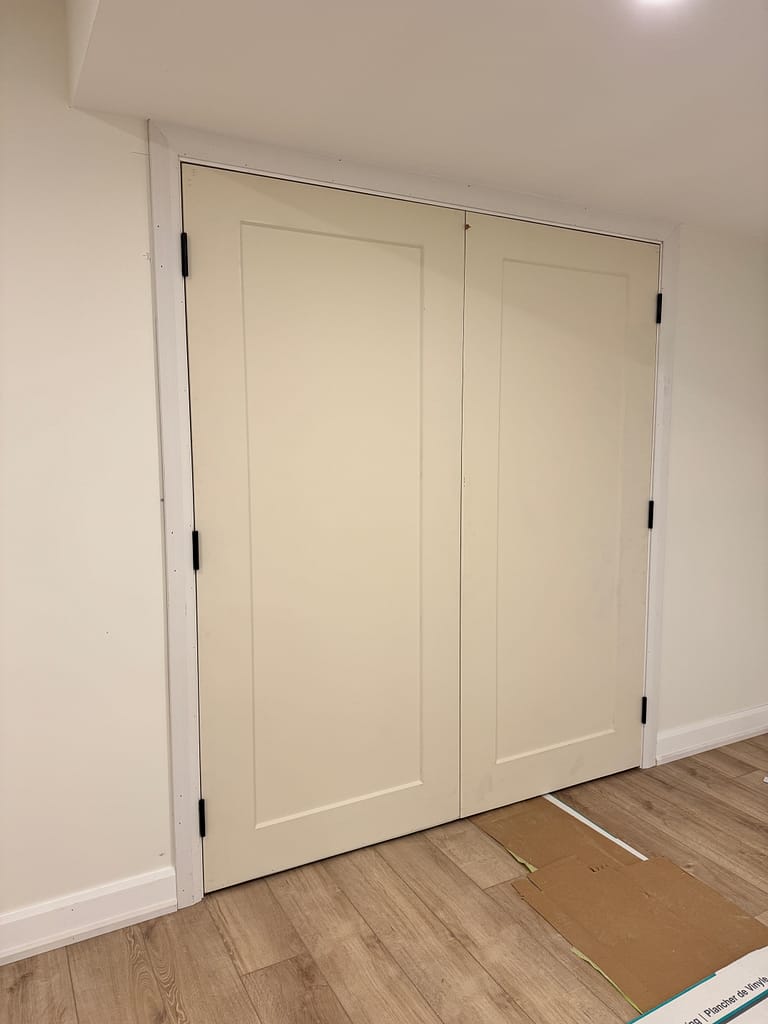
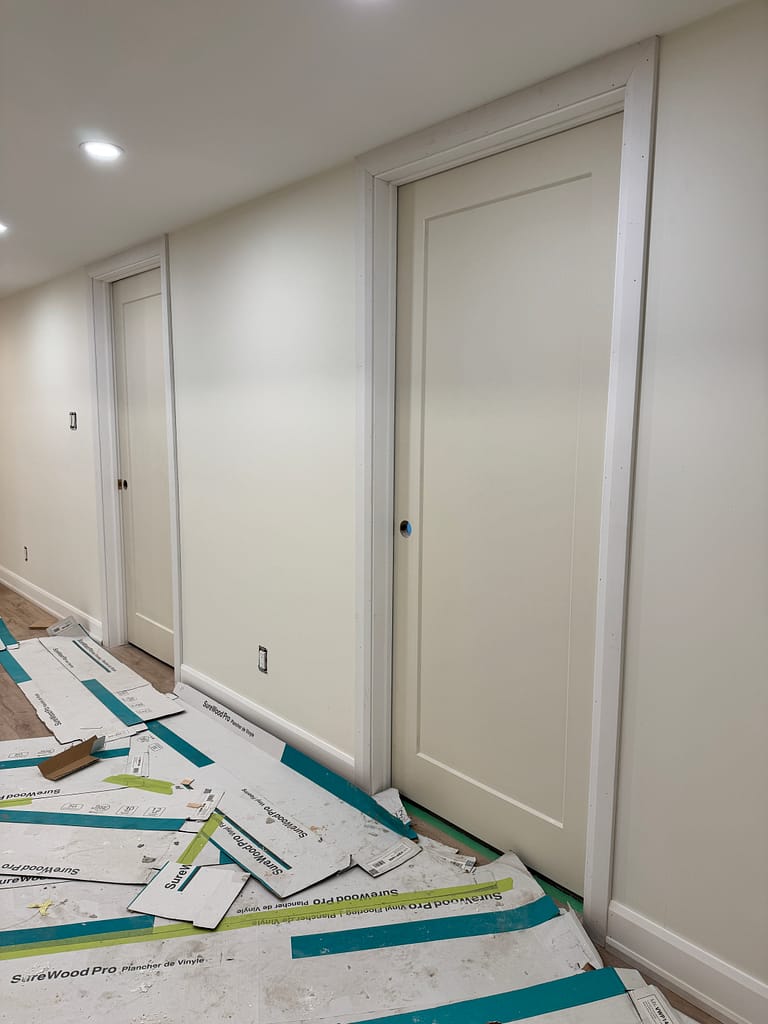
The basement included clean one-panel interior doors and a set of one-panel double doors.
One-panel doors are a good choice in many basement spaces because they look simple, clean, and less busy than six-panel doors. They also work well with modern casing, baseboards, and wall paneling.
The door work included:
- One-panel basement doors
- One-panel double doors
- Door casing
- Baseboards
- Clean trim transitions
- Openings prepared for final paint and hardware
A basement door package is rarely only about the door slab. The casing, baseboard, reveal lines, hinge side, and latch side all affect how the finished opening feels.
Wood Job explains this more broadly on the main interior door installation and replacement service page.
Why the Board and Batten Wall Changed the Space
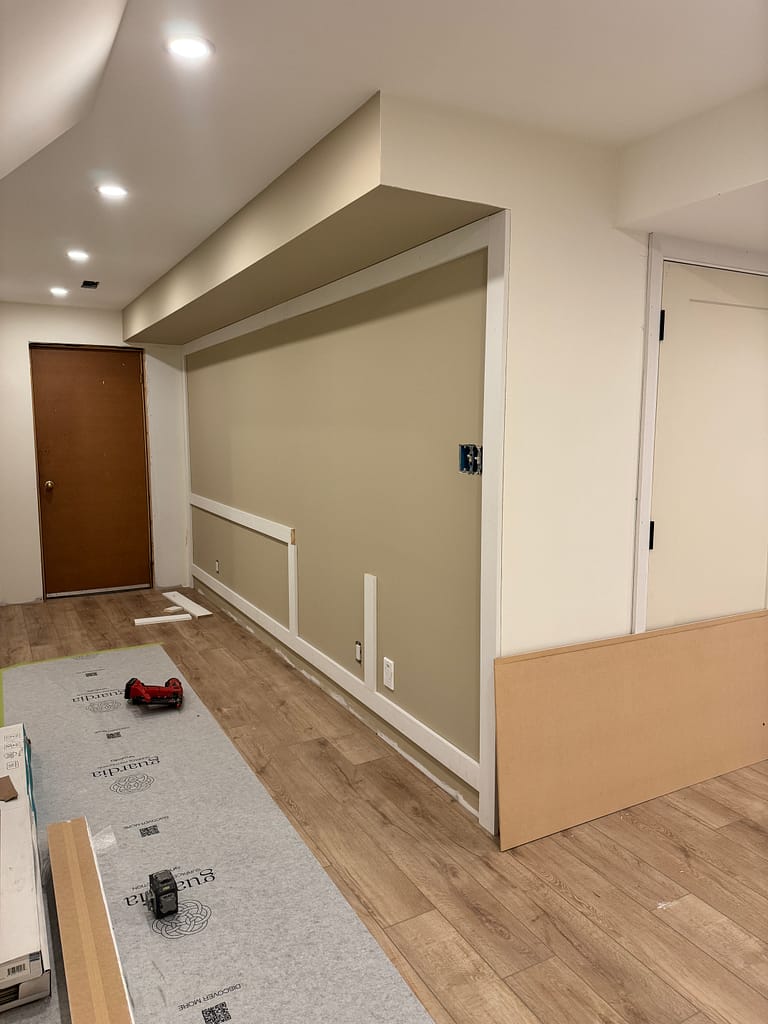
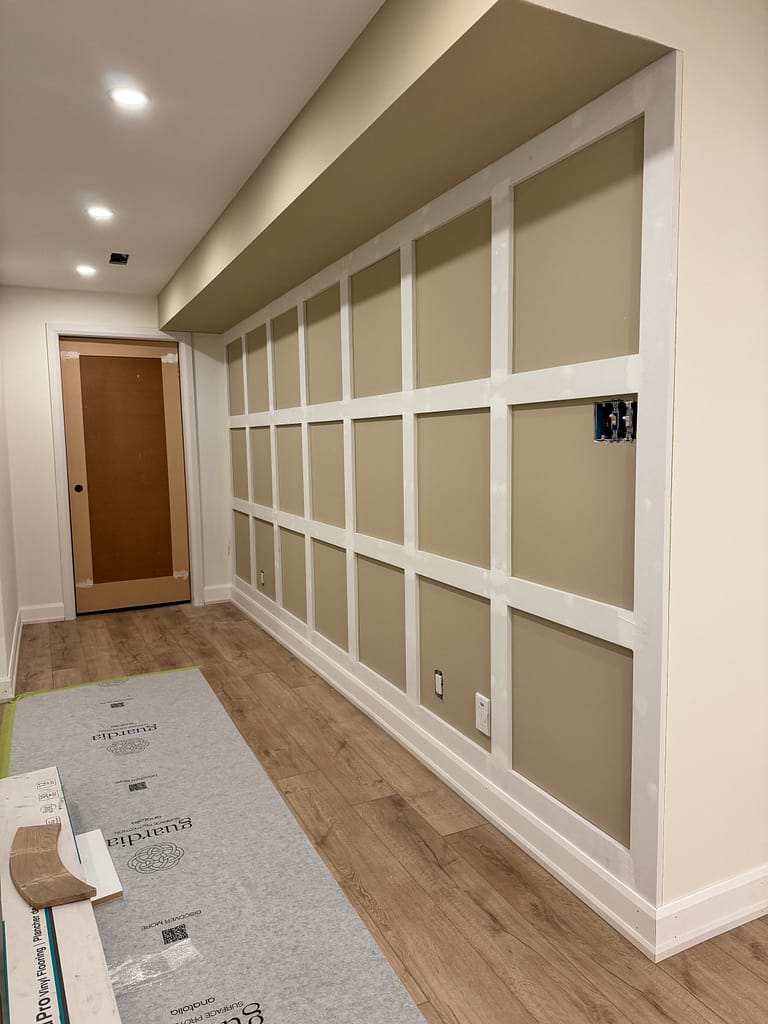
The board and batten detail gave the basement entry wall a stronger presence.
This kind of wall detail has to be planned before the first piece is installed.
The spacing has to work with:
- Wall length
- Ceiling height
- Bulkheads
- Outlets and switches
- Door openings
- Baseboards
- Casing
- The way people enter the space
If the layout is rushed, the wall can look random even when every piece is cut cleanly.
In this project, the board and batten wall was installed so the long basement wall felt planned, not empty. The trim detail gave the basement a more finished first impression without turning it into a complicated feature wall.
For similar wall details, Wood Job’s service page for custom accent walls, shiplap, board and batten, and wainscoting explains how these layouts are planned around real wall conditions.
The Cold Room Door Could Not Stay Plain
The cold room door was the detail that could easily have been missed.
It was a functional door.
But it sat inside the same visual area as the new board and batten wall.
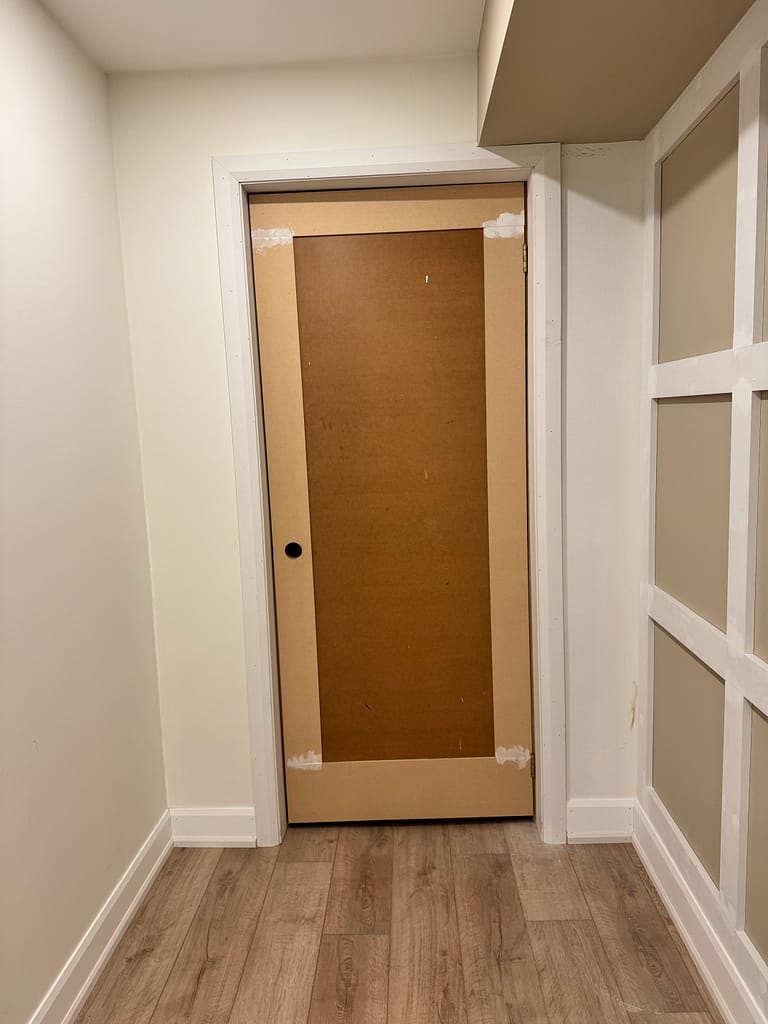
If the wall became panelled and the cold room door stayed completely plain, the door would pull attention for the wrong reason. It would look like the design stopped when it reached the door.
So Wood Job added panel detailing to the cold room door.
The idea was to connect three things:
- The basement’s one-panel interior doors
- The board and batten wall design
- The plain cold room door that needed to feel less separate
This small decision made the cold room door feel more intentional.
It did not need to become a fancy door.
It just needed to belong.
Why This Detail Matters in Real Homes
A basement often has practical doors: cold room doors, storage doors, furnace room doors, mechanical room doors, and utility access doors.
These doors are easy to ignore during planning.
But once the basement is finished, they are still visible every day.
If the main doors are clean, the casing is sharp, the baseboards are installed, and the wall has a board and batten feature, a plain leftover door can make the whole area feel unfinished.
This is where finish carpentry becomes more than cutting trim.
It becomes the work of making the details speak the same language.
The doors, casing, baseboards, and wall paneling should feel connected.
Wood Job covers the trim side of this work on the finish trim carpentry service page.
Working Around the Real Basement
Basements are rarely perfect showrooms.
They often have:
- Bulkheads
- Low ceilings
- Utility access points
- Cold rooms
- Storage doors
- Narrow halls
- Uneven drywall
- Flooring transitions
- Electrical boxes
- Existing framing conditions
This project had to work with the real basement, not just the idea of a clean wall.
The board and batten layout had to respect the door openings and electrical locations. The casing had to work with the wall detail. The baseboards had to continue cleanly through the space. The cold room door had to be treated as part of the whole design.
That is the part homeowners often do not see before the work starts.
Small decisions on site decide whether the final basement feels clean or pieced together.
A Related Milton Basement Door Project
Wood Job has completed other basement door work in Milton where the openings needed careful thinking.
One related project involved custom jambs and interior door installation for a Milton basement unit, including non-standard opening conditions and careful door fitting.
You can see that project here: Custom Door Jambs and Interior Door Installation for a Milton Basement Unit.
The lesson is similar:
Basement doors should be chosen and fitted for the actual openings, not only for the product label.
What Future Homeowners Can Learn From This Project
If you are planning a finished basement, do not think about the doors, trim, and wall details separately.
Before ordering materials, it helps to ask:
- Which doors will be seen first?
- Are there cold room, storage, or utility doors that need to look cleaner?
- Should the basement doors all have the same style?
- Will the wall paneling meet door casing?
- Where will the baseboards stop or continue?
- Are there outlets, switches, or bulkheads in the feature wall?
- Is the basement already painted, or will painting happen after carpentry?
- Should a plain door be customized so it fits the rest of the design?
These are not huge design questions.
But they change how the basement feels when the work is done.
Owner-Led Finish Carpentry in Milton
Wood Job Finish Carpentry is owner-led and intentionally small.
That matters on projects like this because the final result depends on small decisions made in the room.
Where should the board and batten layout start?
How should the cold room door be treated?
Does the casing need to stay simple or become part of the wall detail?
How should the baseboard continue around the corner?
These are practical finish carpentry decisions, and they should not be rushed.
Jack Cenk Ozer works directly with the details on site so the doors, trim, and wall paneling feel connected when the project is ready for paint.
Planning a Basement Door, Trim or Wall Paneling Project in Milton?
If you are planning basement doors, casing, baseboards, wall paneling, board and batten, or a small custom door detail, send clear photos before ordering materials.
Helpful photos include:
- The full basement wall
- Each door opening
- Existing cold room or storage doors
- Nearby doors you want to match
- Ceiling or bulkhead conditions
- Outlets and switches on the wall
- Baseboard areas
- Flooring condition
- Any inspiration photo you like
Also include your project city, rough measurements, number of doors, and whether painting will happen before or after the carpentry.
Wood Job can review the details and let you know whether a rough estimate is possible from photos or if a walkthrough would be better.
You can start here:
FAQ
Can board and batten be installed in a basement?
Yes. Board and batten can work well in a basement when the layout is planned around the real wall, ceiling height, bulkheads, outlets, switches, doors, casing, and baseboards. The spacing matters before the first piece is cut.
Can a plain cold room door be made to match the basement design?
Often, yes. A plain cold room or storage door can sometimes be customized with MDF panel detail so it feels closer to the surrounding doors or wall paneling. The right approach depends on the door material, opening size, hardware, and final paint plan.
Should basement doors and wall paneling be planned together?
Yes, especially when the doors are on the same wall as the panel detail. The casing, panel spacing, baseboard height, door style, and electrical locations all affect the final look.
Are one-panel doors a good choice for basements?
One-panel doors can be a good choice for many finished basements because they look clean and work well with simple trim, modern casing, baseboards, and wall paneling. They are also less visually busy than six-panel doors.
Can Wood Job install both basement doors and board and batten?
Yes. Wood Job can handle interior door installation, casing, baseboards, and board and batten wall details as part of the same finish carpentry project, depending on the scope and location.
Should I buy basement doors before a finish carpenter checks the openings?
For standard openings, it may be straightforward. But in basements, openings can be affected by bulkheads, low ceilings, framing, flooring, and storage areas. It is better to send photos and measurements before ordering doors.ors or rooms involved, and a short description of what needs to be completed. If the details are straightforward, a rough starting range may be possible from photos. If the openings or site conditions need a closer look, a walkthrough may be the better next step.
Do you only provide basement doors and board and batten work in Milton?
No. Wood Job Finish Carpentry works in Milton and also serves nearby cities across Halton, Waterloo Region, and the GTA.
You can view local finish carpentry service pages for Oakville, Milton, Burlington, Mississauga, Cambridge, Guelph, Kitchener, Vaughan, Hamilton, and Toronto.
If your project is outside these cities but nearby, send your location with a few photos and a short description. Wood Job can let you know whether the project is within service range.
Related Services
Finish Carpenter in Milton
See how Wood Job Finish Carpentry helps Milton homeowners with doors, trim, baseboards, casing, fireplace details, window extensions and renovation finishing.
Interior Door Installation in Milton
Interior doors, double doors, French doors, hardware, reveals, jambs, and custom fitting for finished residential spaces and existing interior openings.
Finish Trim Carpentry
Casing, jambs, baseboards, door trim, window trim, reveals, transitions, and final finish details that help a custom door system look built into the home.




